jeudi 4 décembre 2014

Space Detective #1-4 (1951-1952)

Chez Avon, le même éditeur que Strange Worlds, la brève série Space Detective contient aussi un peu de Wallace Wood (mais le Grand Comic Database m'apprend que c'est plutôt du Joe Orlando encré par Wally Wood et non l'inverse). Ils n'ont en revanche fait que le premier numéro sur 4 et les artistes changent ensuite à chaque fois.

Les histoires de Space Detective sont très répétitives : toujours en 3 chapitres qui se déroulent soit dans l'espace soit dans une des planètes de notre système solaire, avec à chaque fois une nouvelle espèce indigène et un criminel qui réussit à s'enfuir jusqu'au 3e chapitre. La première histoire en tout cas est attribuée à Walter Gibson (1897-1985), vétéran hyperprolifique des Pulps qui rédigea des centaines d'histoires de The Shadow (24 romans rien que pour l'année 1933).

Si la série avait continué, ils auraient fini par ne plus avoir de nouvelles planètes disponibles, même s'ils commençaient à passer aux satellites. Le système de Space Detective comprend notamment comme espèces les Salamandres de "Vulcain", les Sylphides des forêts de Mercure, les Gnomes taupes de Jupiter, les Elfes des Fleurs de Ganymède, les Esclavagistes de Saturne et enfin les Néréides de Neptune. Un effort est fait pour que le McGuffin rare du scénario ne soit pas toujours du minerai (platine ou thorium) ou une source d'énergie (il y a des essences de fleurs de Ganymède et des perles marines de Neptune). Le fait que l'esclavage soit toléré dans toute une partie du système n'a l'air de déranger personne (l'esclave saturnienne garde son statut sur Mars).

Space Detective #1 (juillet 1951)
Bandits of the Starways (script : Walter Gibson, art : Joe Orlando & Wally Wood)
Rod Hathway est un millionnaire philanthrope de Great New York (métropole terrienne qui a dû absorber une partie de la Côte Est). Il prend l'identité du "Vengeur" pour lutter contre le crime dans le système solaire du futur (et sa belle secrétaire Dot Kenny prend alors le nom de Teena). Quand le vaisseau Arrow est attaqué par des bandits entre la Terre et Grebhar, capitale de l'Etat Libre de Vénus, Rod Hathway soupçonne aussitôt Set Maag, bandit martien de Ferrok Shan (nom de la capitale de l'Union martienne qu'on retrouvera dans Strange Worlds #9 - il y a un peu de cohérence pour une fois !). Il vient comme le Vengeur voir l'Inspecteur Greer de la Patrouille Interplanétaire et est persuadé que le gang interplanétaire de Set Maag va cibler le Star Queen, en partance pour Ferrok Shan.

Rod Hathway remarque par son signalement (une de ses jambes est cyborg) que Set Maag s'est déguisé en Sirrah Vendoza, un riche passager vénusien. Set Maag tente de prendre le contrôle du vaisseau avec ses hommes infiltrés mais est déjoué par le Vengeur, avant de s'enfuir vers un Vaisseau pirate invisible.

The Opium Smugglers of Venus (mêmes auteurs)
4 ans ont passé depuis l'affaire du Star Queen. Sirrah Vau, de l'Etat Libre de Venus, se plaint que la Terre ne fasse pas assez contre les Trafiquants d'Opium. Le Vengeur, venu à Grebhar, découvre que Sirrah Vau est en fait impliqué dans le trafic, qui est en partie une fausse piste (la drogue est produite sur place) et que la célèbre actrice Serra Venta (rencontrée dans l'épisode précédent) utilise ces narcotiques. Vau (qui n'est autre que Set Maag, le Meurtrier Martien) tue Serra Venta quand elle va commencer à parler au Vengeur et enlève ensuite Teena. Quand le Vengeur les retrouve, Set Maag s'enfuit à nouveau et fait sauter sa base avec une bombe atomique.

Trail to the Asteroid Hideout
A Ferrok Shan, le Vengeur interroge en hypnotisant un des hommes des Set Maag, un Nain Martien des Collines qui lui révèle un plan d'attaque des banques de Mars. Mais quand leur vaisseau est capturé par Set Maag vers sa base secrète dans la Ceinture d'Astéroïdes, le Vengeur réussit à inverser la situation en arrêtant enfin son ennemi si fuyant.

Le reste du magazine a aussi une histoire policière et une page "d'humour".

Space Detective #2 (novembre 1951)

Cette fois Wally Wood & Joe Orlando ne dessinent plus que la Couverture et la Table des matières, les auteurs du reste sont inconnus.

Batwomen of Mercury!
Les masques d'Halloween de cette année représente la Gargouille, un dangereux criminel évadé (qui est encore pire dans la mutation déformée que Set Maag), et le Vengeur interroge le fabriquant qui est relié à ce vieil ennemi et lui a fabriqué un masque pour mieux se dissimuler. Il apprend que la Gargouille s'est enfui vers la Cité Forestière de Mercure. Là, la Gargouille libère les Femmes-Chauve-Souris, des créatures semi-intelligentes volantes de Mercure. Le Vengeur et Teena reçoivent l'aide d'une ancienne alliée, Ahla, chef de la Patrouille volante des Femmes ailées qui luttent sur Mercure contre les Femmes-Chauves-Souris. Mais quand ils retrouvent le nid de ces dernières dans les Skye Mountains, la Gargouille réussit à s'enfuir.


The Metal Murderers of Mars!
Sur Mars, la Gargouille revient en provoquant une révolte des Robots de la planète pour aider son plan de voler la Banque centrale martienne. Il s'enfuit quand le Vengeur lance les robots contre lui et ses hommes.

Slave-Ship of Saturn!
La Gargouille s'est alliée à une ancienne esclave de Saturne (ce qui doit être des colonies humaines là-bas, un cliché "orientaliste" sur des principautés du Moyen-Orient qui pratiquent encore l'esclavage et chevauchent des dobermans géants). Ces pirates attaquent des vaisseaux pour enlever la cargaison servile. Le Vengeur semble collaborer avec la police saturnienne pour les récupérer (l'épisode est surtout un prétexte pour que Teena s'habille en esclave et se fasse vendre à un Prince saturnien) mais quand il arrête finalement la Gargouille et son alliée, il en profite pour libérer les prisonnières sur la Terre où elles sont affranchies.

The Case of the Sub-Sea Bandits (dessiné par HC Kiefer)
Jac Lombard, des services secrets Shadow Squad de l'an 2000 (qu'on retrouve aussi dans Strange Worlds #8) enquête sur un sous-marin géant en Espagne (dans cette version écrite du temps de Franco, la monarchie n'a jamais été rétablie). C'est vraiment une BD très soporifique.


Space Detective 3 (février 1952)
(couverture par Everett Kinstler, sans rapport avec le contenu)

Pearl Ship of Death (auteurs inconnus)
Rod Hathway vient d'offrir un collier de perles neptuniennes à Dot/Teena quand ils reçoivent pour mission de protéger une cargaison de perles neptuniennes dans le vaisseau Star Arrow, qui va de la Terre à Grebhar sur Venus. Ils sont attaqués par des bandits des collines neptuniennes (c'est un des clichés de la série : les gangs recrutent toujours dans les collines de chaque planète). Ils rencontrent le Caméléon, maître du déguisement (mais tous les autres adversaires du Vengeur avaient tous ce talent), et sa troupe composée de Xaga, une Femme-Taupe de Jupiter (qui ont des antennes), et de Nereid, une Neptunienne. Teena propose de danser avec eux pour les surveiller et quand Nereid tente de l'avertir d'un complot du Caméléon pour voler la cargaison de perles, le Vengeur réussit à le faire s'enfuir vers son vaisseau invisible qui suivait le Star Arrow.

Sea Nymphs of Neptune
Le Vengeur et Teena vont sur Neptune à l'appel de Nereid. Le Caméléon a pris une identité d'un chef des Chasseurs de Perles et a enlevé la soeur de Nereid. Le Vengeur doit affronter des Octo-Monstres, céphalopodes neptuniens.

Mole Woman of Jupiter
Le Vengeur vient sur Jupiter pour arrêter Xanga, qui a poussé les Hommes-Taupes primitifs de Jupiter à attaquer les villages des Montagnes pour voler les minerais rares. Ils arrêtent enfin Xanga la Jovienne et le Caméléon (exactement comme ils avaient arrêté la Pirate saturnienne et la Gargouille...). Teena se sert notamment d'un onguent qui lui permet de résister au feu.

Revolt of the Robots!
En l'an 2000, un certain Targan apparaît dans le Nevada et se fait engager dans des mines où il commence progressivement un processus de robotisation du travail. Les ouvriers humains finissent par manifester contre la suppression de leurs emplois mais Targan tente alors un soulèvement des robots. Quand il est vaincu par le fils du patron de la mine (les comics américains ont quand même plus tendance que nos BD à prendre un héros qui est du côté des patrons), on découvre que ce mystérieux Targan était en fait un robot venu du XXIVe siècle dans une machine à voyager dans le Temps. Oui, ce Terminator n'avait rien trouvé de mieux dans son projet anti-humain que d'infiltrer d'abord une mine perdue dans le Névada...

Space Detective #4 (juillet 1952)

Space Ship of the Dead (dessins de Gene Fawcette)
L'Homme-Bête est un tueur en série au visage de Troll simiesque qui assassine uniquement des personnes belles pour les voler (mais il simule en partie sa folie). Il s'évade de son asile et tente d'assassiner Dot avec un parfum de Ganymède. Le Vengeur et Teena vont vers le Star Queen (j'ai l'impression qu'il n'y a que deux vaisseaux dans tout ce système solaire...) qui doit justement apporter sur Venus une cargaison précieuse de parfums rares de Ganymède (qui valent des millions de "décimars", monnaie aussi utilisée dans une histoire de Strange Worlds #9 en novembre 1952, dommage que les noms des scénaristes ne soient pas connus). Les agents de l'Homme-Bête utilisent un procédé qui les transforment en Squelettes translucides (sans qu'on comprenne bien l'intérêt en dehors du graphisme). Le Vengeur sauve la cargaison contre l'Homme-Bête et son associée, Vola la Vulcanienne (oui, dans le système solaire de Space Detective, cette planète hypothétique du XIXe siècle entre le Soleil et Mercure existe vraiment).

Attack of the Wasp Women
Fay, une des petites Elfes  des Fleurs de Ganymède (qui a l'air de ne pas faire plus que 60cm ?), appelle le Vengeur à l'aide contre les assauts des Femmes-Guêpes qui leur volent les essences des Fleurs. Elles travaillent bien sûr pour l'Homme-Bête et Vola de Vulcain. Mmmh... un Troll qui fait travailler des femmes-guêpes contre des Pixies ou des Elfes. On est vraiment sur Glorantha.


Flame Women of Vulcan
Des Femmes de Flammes des profondeurs attaquent les mines de thorium de Vulcain (le principal fuel du système solaire). Munies d'un rayon de lumière noire pour se rendre invisibles, le Vengeur et Teena enquêtent dans la Mine. Les Femmes de Flammes sont manipulées par Vola qui utilise un trucage pour se faire passer pour l'une d'elles. L'affaire se termine mal pour les deux criminels qui brulent dans une explosion.

Cargo from Mars (art : Gerald McCann)
George La Grange, agent du service d'Immigration terrien, enquête sur un réseau de passeurs criminels qui fait venir sur Terre par une station du Pôle nord des fugitifs humains de Mars mais aussi des sauvages clandestins indigènes des Grottes Brunes de Mars. Il n'est jamais expliqué clairement pourquoi ce contrôle de l'immigration martienne est si important et l'histoire est particulièrement bizarre (comme le fait que les agents de ce réseau n'ont rien trouvé comme signe d'identification que de graver des signes dans le bras).

Source :  http://anniceris.blogspot.fr/2014/03/free-comics-space-detective-1-4-1951.html

Philosophical SF (Science Fiction / Speculative Fiction): Four Lists and a Project

I'm increasingly convinced that science fiction, or more broadly, "speculative fiction" is a powerful philosophical tool. The specificity of the possibilities considered, and its emotional and imagistic power, engages parts of the mind that more abstract forms of speculation leave hungry. Possibilities are livened, affecting how we think about them.
Suppose you agree.  What might you want to read (or watch)?
A couple dozen professional philosophers who enjoy SF, and two SF writers with graduate training in philosophy, have agreed to offer me lists of ten "personal favorite" works of philosophically interesting SF, along with brief "pitches" pointing toward the works' philosophical interest. I'll be rolling out these lists four at a time on the blog.  At the end, I will compile a mega-list of all the lists, as well as some observations about the aggregate results.
I emphasize that individuals' lists are not intended as thoroughly researched "top ten" lists -- just suggestions of some works that the contributors have enjoyed and found philosophically engaging.
If you are a professional philosopher (or an SF writer with graduate training in philosophy) and you would like to contribute a list, email me. (Corrections are also welcome.)
Any reader who wishes to add one or more suggested works to the comments section, please feel free!
So, the first four lists:
----------------------------------------------
List from Josh Dever (Associate Professor of Philosophy, University of Texas at Austin):
Mark Danielewski, House of Leaves (novel, 2000). The opening of chapter 4 is a beautiful test case in whether a tiny datum can drive a massive theory change.
Samuel Delany, Dhalgren and Triton (novels, 1975 and 1976). Explorations of just about every imaginable alternative sociological and political structure and theory.
Philip K. Dick, Radio Free Albemuth (novel, 1976). Time stopped in the first century AD, and restarted in 1945. Come up with a theory of time to make that consistent!
Russell Hoban, Riddley Walker (novel, 1980). Like that Star Trek episode “Darmok”, except, you know, good. Also, best post-apocalyptic novel ever by a significant author of children’s literature.
Sigizmund Krzhizhanovsky, “Quadraturin” (short story, 192-something). There’s a superabundance of science fiction about weird physics and metaphysics of time, but a disappointing dearth of the same with space. This is an exception.
Ursula K. Le Guin, “The Author of the Acacia Seeds, and Other Extracts from the Journal of the Association of Therolinguistics” and “The Ones Who Walk Away From Omelas” (short stories, 1982 and 1973). The first: always nice when science fiction remembers that linguistics is a science. The second: a powerful counterexample, but note only to certain forms of consequentialism. Think of it as an argument for good social choice theory.
China Miéville, Embassytown and The City & The City (novels, 2011 and 2009). The first is a fun, if a bit clunky, bit of exploratory philosophy of language. The second is a particularly adventurous instance of exploratory metaphysics.
Thomas Pynchon, Mason & Dixon, Episode 19 (portion of a novel, 1997). The story of the missing eleven days resulting from the transition from the Julian to the Gregorian calendar. More fun metaphysics of time, plus a bit of philosophies of language and gender.
David Foster Wallace, Infinite Jest (novel, 1996). Philosophy by virtue of mentioning “Montague Grammar and the Semantics of Physical Modality”, science fiction by virtue of being set in the Year of the Depend Adult Undergarmet, fun by virtue of including basically everything in between.
H.G. Wells, “The Remarkable Case of Davidson’s Eyes” (short story, 1895). The definitive counterexample to immunity to error through misidentification.
----------------------------------------------
List from Lewis Powell (Assistant Professor of Philosophy at University at Buffalo, SUNY)
Leonard Richardson, Constellation Games (novel, 2012): Aliens make first contact, and Ariel Blum’s first reaction is to hope that they’ll let us play their video games. They do. The novel is much better than this premise would lead you to expect. Examines issues in social/political philosophy concerning scarcity of resources (and post-scarcity societies), anarchism and social organization, the (dis)value of immortality, and the role of art and games in human life.
Ursula K. Le Guin, The Dispossessed (novel, 1974): A gripping story investigating a society that has embraced and internalized a full-blown communalism. Examines issues of privacy and property, and the individual’s relationship to society.
Ursula K. Le Guin, The Left Hand of Darkness (novel, 1969): first contact story about someone encountering a society with radically different manifestations of gender roles, sexuality, and social norms. Examines issues of gender and sexuality, as well as love and friendship.
Ted Chiang, “Hell is the Absence of God” (short story, 2001): Story set in a world where everyone has concrete evidence of the existence of God and an afterlife, but no better understanding of why there is suffering. Examines issues in philosophy of religion, epistemology, the problem of evil and divine hiddenness.
Ted Chiang, “Division By Zero” (short story, 1991): one of the few works I’ve seen of mathematical science fiction (rather than empirical science fiction), impressive treatment of the possibility that arithmetic is inconsistent.
Ted Chiang, “Story of Your Life” / “Evolution of Human Science” (short stories, 1998/2000): These stories are very different, but both raise fascinating questions about the nature of science, the role of humans in science, and the consequences of dealing with scientific progress that exceeds the understanding of individual humans.
PD James/Alfonso Cuaron, The Children of Men (novel, 1992/movie, 2006): While there are a number of plot differences between the film and the book, both do an excellent job of investigating reactions to an existential threat to humanity arising from total infertility.
Star Trek: The Next Generation, “Who Watches the Watchers” / “First Contact” / “Thine Own Self” (tv episodes, 1989/1991/1994): The prime directive (non-interference with less advanced civilizations) is one of the most fascinating elements from Star Trek. These episodes do an excellent job of exploring the ethics of non-interference and undisclosed observation, and raise questions about the withholding of beneficial advances required by it.
Mary Shelley, Frankenstein (novel, 1818): It seems almost unnecessary to list this work, which is such a widely read classic. Shelley’s tale of the “modern Prometheus” does an exceptional job of raising questions about the nature of humanity and the ethics of creating life.
China Miéville, Embassytown (novel, 2011): A novel about people trying to interact with an alien race who think and communicate in a fundamentally different manner than us. A more sophisticated take on this concept than the TNG episode Darmok, and with considerably more interest for philosophers of language.
----------------------------------------------
List from Amy Kind (Professor of Philosophy, Claremont McKenna College) (short stories only):
Isaac Asimov, “Evidence” (1946). Probes the plausibility of the Turing Test.
Jorge Luis Borges, “The Immortal” (1947). An intriguing exploration of why immortality may not be quite what we’d bargained for; pairs well with Bernard Williams’ “The Makropulos Case: Reflections on the Tedium of Immortality.”
Octavia Butler, “Bloodchild” (1995). Explores the nature of gender roles via a story about an alien race who need humans for procreative purposes.
Arthur Clarke, “The Nine Billion Names of God” (1953). Could God’s having a purpose for us provide our lives with meaningfulness?
Greg Egan, “The Infinite Assassin” (1991). How are we related to our counterparts throughout the multiverse?
Lois Gould, “X: A Fabulous Child’s Story” (1972). What role does gender identity play in our lives? What would life be like without it?
Ursula K. Le Guin, “Nine Lives” (1968). What is it like to be a clone? And more specifically, what is it like to have one’s connection to other clones severed after having been raised together with them?
John Morressy, “Except My Life3” (1991). Another story probing questions of identity via consideration of what life might be like when you’re one of a set of closely connected clones.
Norman Spinrad, “The Weed of Time” (1970). What would it be like to experience time in a non-linear fashion?
Roger Zelazny, “For a Breath I Tarry” (1966). A beautiful depiction of a machine’s quest to understand what it is like to be human. (See also Isaac Asimov’s novella, Bicentennial Man and Kurt Vonnegut’s “EPICAC”)
----------------------------------------------
List from Steven Horst (Chair of Philosophy, Wesleyan University)
C.S. Lewis, Space Trilogy (Out of the Silent Planet / Perelandra / That Hideous Strength (novels, 1938-1945). Notable for using the sci-fi genre to explore Christian ideas of the fall, intelligent aliens, angels, celestial intelligences, magic, and the dangers of totalitarianism wrapped in the mantle of science.
Neal Stephenson, The Baroque Cycle (Quicksilver / The Confusion / The System of the World (novels, 2003-2005). Set as historical novels and developed around the core of interactions between Newton and Leibniz, explores the origins of modern systems of science and finance in counterpoint with alchemical memes.
Neal Stephenson, Anathem (novel, 2008). At the risk of a major spoiler, this book explores ideas of the quantum multiverse, with the added bonus that some characters are stand-ins for the views of people like Husserl, Gödel, and Bohr.
Madeline L’Engle, A Wrinkle in Time / A Wind in the Door / A Swiftly Tilting Planet (novels, 1962-1978). This may have been my first introduction to science fiction as a child, and while it is not the most intellectually challenging series about time travel (and dimensional travel, in the case of the memorable Cherubim that is both singular and plural), it is perhaps still the most memorable and endearing.
Andy & Lana Wachowski, The Matrix (movie, 1999). Not only the most influential movie about virtual reality, but one that implicitly poses interesting questions about what counts as “real”, as the Matrix-world is both the world we assume to be reality and is thoroughly intersubjective.
Larry Niven, Ringworld and sequels (novels, starting 1970). An enormous engineered world encircling a distant star provides a context for exploration of the variability of the human phenotype and contrasts with two alien species and a third that turns out to not be as alien as we first imagine.
Star Trek: The Next Generation, “The Measure of a Man” (TV episode, 1989). The trial to determine whether the Android Data is a person or the property of Star Fleet provides the context for an engaging exploration of personhood and artificial life.
Battlestar Galactica (TV series, 2003-2009). Over six seasons, we are drawn into an increasingly complicated dialectic about the original metallic Cylons, the Cylon “skin jobs”, and by implication, the nature of humanity and personhood, as well as some teaser forays into shared virtual reality that were to be explored in the uncompleted prequel series Caprica.
Fred Hoyle, The Black Cloud (novel, 1957). The late British astronomer’s novel starts out looking like a novel about a disaster from deep space, but takes a turn to explore the prospects of communication with an alien intelligence very different from ourselves.
J.R.R. Tolkien, “Ainulindalë” (in The Silmarillion, published 1977). Tolkien’s Neo-Platonic creation myth puts the rest of the stories about Middle Earth in a distinctly different cosmic context, hints of which can be seen in the better-known works only after one has read the cosmic “backstory”.

List from Pete Mandik (Professor of Philosophy, William Paterson University, and co-host of SpaceTimeMind):
Peter Watts, Blindsight (novel, 2006). Cogsci savvy tale in which assorted transhumans and extraterrestrials get by just fine without phenomenal consciousness...or do they?
Ted Chiang, “Understand” (short story, 1991) Thorough and convincing first-person phenomenology of human super intelligence--you’ll feel like you know what it’s like to get your IQ quadrupled overnight.
Greg Egan, Diaspora (novel, 1997) Living indefinitely long as a godlike digital posthuman is all well and good, and when you run out of physical universe(s) to explore, there’s solace to be had in math.
Black Mirror, “Be Right Back” (TV show, 2013) Digital simulacra of the recently departed may be exactly what the grief-stricken don’t want but can’t help but seek.
Bruce Sterling, Schismatrix Plus (novel, 1995) Deeply weird political and economic turmoil in a solar system infested by post human factions (genetically engineered vs cyborgs) and, eventually, extraterrestrial investors.
David Gerrold, The Man Who Folded Himself (novel, 1973) Exhaustive exploration of time-travel enabled narcissistic self-indulgence: meet, greet and *expletive deleted* your temporal counterparts.
Charles Stross, Accelerando (novel, 2005) Nothing else that I’ve read comes as close to this in depicting what living through the technological singularity would be like; "mind-bending future shock” is an insufficiently hyperbolic superlative.
Warren Ellis, Transmetropolitan, “Another Cold Morning” (comic book, 1998) Harsh and grim fistful of future shock depicting waking up from cryo stasis into an overwhelming future that has zero use for you.
Tom Scott, “Welcome to Life: The Singularity, Ruined by Lawyers” (YouTube video, 2012) Everyone can have digital immortality, but not everyone can afford a version unsullied by direct brain advertising.
Roger Williams, The Metamorphosis of Prime Intellect (novel, 1994) A virtual god, subservient to Asimov’s laws of robotics, emerges from the technological singularity, and the ensuing cosmic paternalism puts every human into a heaven they desperately want out of, despite (or because of) all the sex and ultraviolence.
----------------------------------------------
List from Eric Kaplan (TV writer and blogger who did philosophy grad work at U.C. Berkeley):
Olaf Stapledon, Star Maker (novel, 1937) -- What is the purpose of life and history?
Gene Wolfe, The Hero as Werewolf (novel, 1991) -- What is evil? What is the role of universalizability in ethics?
Futurama, “Why Must I be a Crustacean in Love?” (TV episode, 2000) -- What's the relationship between ethics and sociobiology?
Futurama, “Hell is Other Robots” (TV episode, 1999) -- Feuerbach thesis of the origin of religion -- is religion a human creation and if so what purpose does it serve?
Algis Budrys, Rogue Moon (novel, 1960) -- What is personal identity?
Isaac Asimov, The Gods Themselves (novel, 1972) -- What is personal identity?
Theodore Sturgeon, Maturity (short stories, 1947-1958) -- What is the purpose of life? What is a well-lived life?
Lewis Padgett, “Mimsy Were the Borogoves” (short story, 1943) -- Are other conceptual schemes possible?
Eric Rücker Eddison, The Worm Ouroboros (novel, 1922) -- Nietzsche and the myth of the eternal return -- the heaviest thought.
G. K. Chesterton, The Man Who Was Thursday (novel, 1908) -- Theodicy -- why would a good God allow evil?
Alice Bradley Sheldon / James Tiptree, Jr., “A Momentary Taste of Being” (short story, 1975) -- biology and the purpose of life.
----------------------------------------------
List from Simon Evnine (Associate Professor of Philosophy, University of Miami):
Octavia Butler, Parable of the Sower (novel, 1993). Gender roles, and the significance of empathy in discharging our responsibilities for each other.
Michael Flynn, Eifelheim (novel, 2006). Aliens appear in a medieval German village; a deep reflection on love and sacrifice.
Russell Hoban, Riddley Walker (novel, 1980). Hermeneutics: In the far future, a story about people trying to make sense of their distant past (us), told in an invented dialect that makes it equally a problem for us to make sense of them.
Liz Jensen, The Uninvited (novel, 2012). The nature of the adult world, and its relation to children and the future.
Ann Leckie, Ancillary Justice (novel, 2013). Having a divided mind, and the existence of social divisions, take on a whole new meaning when agents are composed of multiple people.
Ursula Le Guin, The Left Hand of Darkness (novel, 1969). The meaning of gender is explored when a male protagonist comes to a planet inhabited by humans who change their gender naturally.
Doris Lessing, The Fifth Child (novel, 1988). How do we deal with the intolerable when we have an obligation to care for it?
Vernor Vinge, A Fire Upon the Deep (novel, 1992). A story involving a variety of kinds of minds, including transcendent minds, human minds infused by transcendent minds, and group minds.
Sarah Waters, The Little Stranger (novel, 2009). How well do we know ourselves?
Gene Wolfe, The Book of the New Sun (4 novels, 1983). A haunting work about the experience of finitude.
----------------------------------------------
List from Helen De Cruz (Postdoc in Philosophy, University of Oxford, and blogger):
Ursula Le Guin, Left Hand of Darkness (novel, 1969). Explores a society where its inhabitants do not have a gender.
Daniel F Galouye, Dark Universe (novel, 1961). What's it like to be blind, not just to be blind but to live in a world where everyone is blind and relies on echolocation?
Daniel F. Galouye, Simulacron-3 (novel, 1964). There are several books and movies on the brains in a vat/deceiving demon theme (e.g., most famously, The Matrix), but if I had to pick a favorite, this would be it.
Roger Zelazny, Lord of Light (novel, 1967). Features naturalistic versions of Hindu gods and reincarnation. Can the status quo be challenged by introducing Buddhism?
Robert Heinlein, The Moon Is a Harsh Mistress (novel, 1966). Heinlein's lunar society exhibits his libertarian ideas, as well as the view that there's no such thing as a free lunch (expressed in the awkward acronym TANSTAAFL)
Robert Heinlein, “Jerry Was a Man” (short story, 1947). Ponders the issue of human rights for nonhuman animals and what it means for someone to be human, with the protagonist, a genetically-modified chimpanzee.
Richard Garfinkle, Celestial Matters (novel, 1996). Assumes that ancient science describes accurately how the world works - so we have things like Aristotelian physics, spontaneous generation, taoist Chinese alchemy, and geocentrism with real spheres in space.
Daniel Keyes, Flowers for Algernon (novel, 1966). On personal identity and mental disability.
P.D. James, Children of Men (novel, 1992). Social criticism and theological reflection focusing on the results of mass infertility.
Richard Matheson, I Am Legend (novel, 1954). If you're the last surviving human in a vampire-apocalypse, does it make sense to want to survive? And who is the monster, to be feared, in a new world populated by vampires?


Sources :  http://schwitzsplinters.blogspot.co.uk/2014/09/philosophical-sf-science-fiction.html et http://schwitzsplinters.blogspot.com/2014/10/philosophical-sf-second-batch-of-lists.html

lundi 17 novembre 2014

Le space opera sur PocheSF

C'est en 1941 que le vétéran apprécié de la SF, Wilson Tucker, inventa le terme "space opera", par esprit de dérision, pour désigner des aventures naïves qui avaient fortement tendance à tirer à la ligne. En effet, l'origine du terme est dérivée ironiquement des "soap opera" (opéra de savon) qui désignait, du temps de la radio américaine, les feuilletons mélodramatiques destinés à encadrer les réclames des grandes sociétés de détergents en tous genres.


Roman d'aventure à l'échelle galactique

Les récits de space-opéra racontent des aventures souvent teinté de fantasy comprenant de l'action, des découvertes et de l'exploration. On y trouve un immense décor comme des galaxies soumises à des régimes impériaux ou dictatoriaux, de puissants protagonistes aux grands enjeux, des énormes flottes de vaisseaux spatiaux et une multitude d'extraterrestres ou de robots. Vastes sagas populaires, l'espace se développe au fur et à mesure de l'exploration de nouvelles planètes, de découvertes de nouvelles civilisations et de guerres galactiques.

Ce genre est à la fois prisée pour ses aventures trépidantes, ses horizons illimités et ses rencontres inattendues, mais aussi méprisée pour ses intrigues à peine démarquées des romans noires ou des romans de guerre, avec souvent le sort de l'univers entre les mains d'un super-héros. Frank Herbert, l'auteur d'une des plus célèbre saga de space-opéra avec "Dune" a su déjouer les pièges de la facilité en retenant pour scène une seule planète sur fond certes d'imperium galactique mais en inventant des combinaisons inédites à partir d'éléments puisés dans un grand nombre de cultures. Le space-opéra domine la production littéraire de SF au cours de l'âge d'or mais commence à régresser dans les années 50. C'est à cette période que le space-opéra va se modifier et passer de la thématique de l'exploration purement géographique à celle du développement de l'espèce humaine.

Le cinéma va redonner ses lettres de noblesse au space-opéra avec le film de 1977 le plus représentatif du genre : "La Guerre des Etoiles" de George Lucas. De même, la télévision vulgarisera ce courant grâce à de nombreuses séries comme "Galactica" ou "Star Trek".


Les maîtres du genre

Edmond Hamilton avec E.E. "Doc" Smith peuvent être considéré comme les pères du space-opera. Le cycle d'Hamilton : "Loups des étoiles", rythmé par le fracas d'immenses batailles spatiales, reste d'une étonnante modernité et propulse le lecteur à travers une myriade de planètes dangereuses, au contact de nombreuses races extra-terrestres et de secrets astronomiques vieux de millions d'années. "Doc" Smith, dans les années 40, avec "Saga du Fulgur" a fait évolué le genre progressivement.

Le genre a acquis ses lettres de noblesse avec des auteurs comme Leigh Brackett, Frank Herbert, John Campbell,C. J. Cherryh, Iain M. Banks, David Brin et surtout Jack Vance qui l'éleva au niveau d'un art véritable.


Plus d'infos

Le space opera d'après le cafard cosmique (http://www.cafardcosmique.com/Le-Space-Opera)

Voyages interstellaires, vaisseaux galactiques grands comme des montagnes, planètes lointaines couvertes de sable ou de neige, héros brave et extra-terrestres impitoyable... voici quelques éléments du space opera tel qu’il est né après la Première Guerre Mondiale, aux Etats-Unis.
Mais depuis, le space-op’ a fait du chemin et se révèle comme l’un des genres les plus ambitieux de ces dix dernières années...


Règle n°1 : le Space Opera, c’est... spatieux

Ce qui compte dans le Space Op, c’est de prévoir grand. Pas question que l’action se situe dans un mouchoir de poche : le Space Op exige au minimum un Empire de proportion galactique, et des centaines de centaines de centaines de planètes.
Prévoyez des planètes mono-décor : planète des glaces, planète des mers, planète désertique, planète jungle, bref de belles planètes identifiables [faudraitt pas que le lecteur s’y perde quand même] qui offrent de beaux paysages. A l’idéal, dessinez une carte en annexe, ça fait toujours plaisir et ça fait plus « vrai ».
De même, les batailles spatiales impliquent à tout le moins plusieurs milliers de vaisseaux de tous format. Faut que ça fuse, que ça vaporise, qe ça désintègre. Donnez leur des noms d’insectes, ça fonctionne bien. N’oubliez pas, bien sûr, quelques vaisseaux mères gigantissimes pour organiser le massacre.
Bref : il faut faire du spectacle, ne mégotons pas sur la quantité. Et n’oubliez pas : vous n’aurez pas vraiment à construire le décor. Tout est dans la tête, alors n’ayez pas peur de faire grand, c’est le même prix.

Règle n°2 : le Space Opera, c’est... en couleur !

La vie est trop courte pour s’habiller triste : dans le Space Op, la mode est en pleine forme. Variez les costumes, faites valser les chapeaux, oser toutes les audaces. Opposez des indigènes boueux en peaux de Schmurk, des dignitaires religieux en robes bariolées et des autocrates couverts de bijoux.
Attention : dans le Space Op, l’habit fait le moine :
  • habillé trop riche = personnage puissant mais véreux
  • habillé sobrement = personnage moral et droit [sauf s’il est en noir, là ça craint].
Les filles peuvent s’habiller court, surtout si elles sont copines avec le Héros, car alors elles sont bombesques. Rappelez-vous que dans le futur, les jolies filles seront toutes en bikini. On arrête pas le progrès.
N’oubliez pas enfin une bonne pelleté d’extra-terrestres. Ca semble évident, mais ça va mieux en le disant. A poil, à plumes et à vapeur, ils seront disponibles en toutes tailles, parfois drôle, parfois effrayant, le maître mot est diversité.
Chaque race de E.T. aura d’ailleurs sa culture, ses mœurs bizarres et ses lubies exotiques. Il faut faire riche, foisonnant, un vrai carnaval.
Que ce ne soit pas crédible ne doit pas vous freiner [cf. Règle n°3]. Lâchez votre imagination, le lecteur a acheté votre bouquin pour ça !

Règle n°3 : le Space Opera, n’est pas euclidien

S’il y a bien quelque chose qui importe peu dans le Space Op, ce sont les lois de la physique. La gravité, on s’assoit dessus. La vitesse de la lumière, c’est dépassé. Le paradoxe temporel, on oublie. Le Space Op doit être avant tout spectaculaire, alors ce qui gêne, on jette.
Tant pis si dans l’espace le son n’existe pas : c’est bien plus sympa les réacteurs nucléaires qui vrombissent et les lasers qui sifflent.
Réfléchissez bien : cette façon de voir n’a que des avantages ! Plus besoin d’essayer de comprendre la « Théorie de la Relativité » pour avoir l’air crédible face à Gregory BENFORD ouStephen BAXTER.
Deux ou trois termes pseudo-techniques sortis de votre imagination, [comme « meta-quantique » par exemple] et hop ! le lecteur ne se rendra compte de rien. Au contraire, il sera ravi ! Et si vous avez besoin d’une invention miracle pour sauver le scénario en perdition, foncez !

Règle n°4 : le Space Opera, ne se prend pas la tête !

Ce n’est pas pour rien que l’on parle souvent du Space Opera comme d’un Western dans lequel l’espace aurait remplacé le Far West : le genre réclame des Héros avec un grand H, et des Vilains avec un grand V. Et un combat final où gagne... devinez qui ?
LE HEROS
Ne faites pas dans la demi-mesure : le Héros est gentil, il n’a peur de rien, et puis c’est bien normal vu que de toutes façon il est beau et de lignée aristocratique. Il peut être accompagné d’acolytes sympas mais pourvus de défauts. Un ou deux défauts, pas trop quand même. Ca aidera le scénario, et ça rendra le Héros encore plus... héroïque. Et puis un mec si sympa a forcément des amis.
LE VILAIN
Il est très très très méchant. Et si possible moche à faire peur. Il est puissant [on croirait presqu’il va gagner !], il est impitoyable. Il est conscient de sa méchanceté, mais il s’en fiche : c’est dire s’il est méchant !
On peut distinguer deux carrières de Méchants :
- le Méchant qui fut gentil dans le passé, voire même qui a un lien de parenté et/ou d’amitié avec le Héros. C’est bien, ça fait tragédie grecque [une tragédie grecque, c’est un space opera en sandales qui pourrait se dérouler à Sparte]. Au moment du dénouement, le Méchant se repentit. Ca vous fait une fin morale. Mais il meurt quand même, parce qu’il a fauté, et qu’il faut pas déconner.
- le Méchant qui est en fait une incarnation du Mal. Dans ce cas, on découvre en cours de récit qu’il y a un Encore Plus Méchant caché derrière, une entité puissante et satanique qui tire les ficelles. Le Diable, à côté, c’est un chic type. Le dénouement passe donc par l’anéantissement total du Méchant [Enfin, total, jusqu’au tome 2]. Ca vous fait une fin à grand spectacle.
L’INTRIGUE
Elle doit tenir en quelques mots : le Vilain fait des misères au Héros, il marque même quelques points contre lui, et au moment où l’on pensait le Héros perdu, paf ! à la surprise générale des enfants de moins de 6 ans, en fait il s’en sort. Héroïquement cela va de soi.
Cependant, attention : simple ne veut pas dire simpliste ! Trop de manichéisme tue le suspense. Prévoir donc quelques traîtrises bien lâches et un retournement de veste spectaculaire, qui permettront de faire rebondir l’action de votre Space Op, le rendront sympathique aux critiques, et fourniront la matière de post enthousiastes sur le Forum du Cafard cosmique.
EXEMPLE : «  Tiens, tiens, on dirait bien que l’Empereur Zhakggg et son épouse viennent nous lancer un ultimatum...  »


Les Auteurs de Space Opera

Intrigues simplistes, batailles galactiques, extra-terrestres vilains tout plein, les auteurs des pulps américains des années 1920 à 1950 ne faisaient pas dans la dentelle. Mais attention : tout n’est pas à jeter.
C’est de façon méchamment ironique que plus tard, en 1941, Wilson TUCKER baptise space opera [sur le modèle de soap opera, les feuilletons sentimentaux sponsorisés par les marques de lessive] ces romans sans profondeur qui privilégiaient le dépaysement et l’action. Le terme a longtemps gardé une connotation franchement péjorative.
Il est vrai que les auteurs américains de SF cherchaient davantage à divertir leurs lecteurs qu’à les faire réfléchir. La fierté nationale des Etats-Unis après la victoire de 1918 leur donner ce ton triomphant :reflets de la puissance américaine, les Empires galactiques qu’ils mettent en scène écrasent leurs ennemis extra-terrestres avec l’assurance d’incarner le Bien. Ils poursuivent la conquête de l’Ouest dans les espaces stellaires. D’ailleurs, certaines intrigues des premiers space op’ sont le décalque des intrigues déjà utilisées dans les pulps spécialisés Western !
JPEG - 2.5 ko
E.E. SMITH
Edgar Rice BURROUGHS et E.E « Doc » SMITH sont les créateur du genre. Edward Elmer SMITH est le premier à avoir situé ses intrigues au cœur de la galaxie. Tout devenait possible ! SMITH est également le premier a avoir développé un cycle sur plusieurs romans. De 1928 à 1954, sa série Fulgur s’est étendue sur 7 volumes, publiés en feuilleton par Astounding Stories.
Ses deux séries phares sont :
- La Série Skylark : La curée des astres ["The Skylark Of Space", 1928], collection "Rayon Fantastique" et trois autres volumes, inédits en français.
- La Série Fulgur [éditions Albin Michel] :
  • « Triplanétaire » [« Triplanetary », 1934]
  • « Le premier fulgur » [« First lensman », 1950]
  • « Patrouille galactique » [« Galactic patrol », 1937]
  • « Le fulgur gris » [« Gray lensman », 1939]
  • « Le surfulgur » [« Second stage lensman », 1941]
  • « Les enfants du joyau » [« Children of the lens », 1947]
  • « Les maîtres du vortex » [« The vortex blasters », 1960]
Deux contemporains de E.E. « Doc » SMITH ont également signés des cycles, parus respectivement dans les années 30 et 50, qui paraîtront sans doute désuets au lecteur d’aujourd’hui mais marquent le sommet d’un genre et d’une époque :
  • Jack WILLIAMSON et « La légion de l’espace »
  • Edmond HAMILTON pour « Les Rois des Etoiles » et « Les Loup des Etoiles ».
Ensuite, la brèche était ouverte, et nombre d’auteurs s’y sont engouffrés, parmi lesquels on peut se permettre de vous recommander :
  • Poul ANDERSON et "Les Marchands interplanétaires", qui exportent l’american way of life dans les étoiles .
  • Murray LEINSTER pour "La Galaxie noire". L’un des plus anciens auteurs de SF contemporaine [il a commencé à publier en 1919 !], l’un des auteurs de pulps les plus prolifiques et les plus oubliés aussi. A lire, avec le recul, pour le plaisir du dépaysement.
  • Isaac ASIMOV : Le cycle de "Fondation". Un cycle qui a un peu vieilli, mais un grand classique du genre, avec lequel ASIMOV a donné une crédibilité scientifique aux pulps. Il a en quelque sorte intelectualisé le Space Op. Signe de son audace : il ose décrire un Empire en perdition !
  • Douglas ADAMS pour son Cycle du Routard Galactique, parodie hautement délirante sur le space-opera dans laquelle tous les clichés du genres sombrent dans le « non sense. Très drôle.
Signalons également :
  • « La Geste des Princes-Démons » de Jack VANCE
  • « Etoiles, Garde-à-vous ! » de Robert HEINLEIN
  • « Babel 17 » et « Nova » de Samuel DELANY
  • « L’Empire interstellaire » de John BRUNNER
  • Fred SABERHAGEN : Le Cycle des "Berserkers", un space opera réussi qui conte la guerre des machines contre les êtres humains.
Citons, parce qu’elles sont assez populaires, les œuvres de :
  • Lois McMASTER BUJOLD : "Miles Vorkosigan"
  • C.-J. CHERRYH : "Forteresse des Etoiles" Ces deux plumes sont efficaces mais bavardes et pas réellement inventives. McMASTER BUJOLD a visiblement tiré à la ligne et l’intérêt des nombreuses suites au son roman s’amenuise avec le temps.
En France, Gérard KLEIN ou Francis CARSAC ont exploité joliment le filon, à la française, c-a-d à la fois avec plus de profondeur... et moins de spectacle.


Le Renouveau des Années 90

Le renouveau du Space Opera dans les années 90 passe par une plus grande préoccupation pour l’Humain. Les personnages passent au premier plan, et si l’action et le dépaysement restent des éléments essentiels, les pensées et les questionnements des protagonistes sont le sujet du roman.
C’est à Dan SIMMONS et son « Hypérion » [1990], que le doit LE grand retour du space opera. Son récit construit avec maestria renouvelle le genre en respectant la recette. Un tour de force qui a su prouver que la mega-saga galactique n’était pas condamné au manichéisme.
David BRIN à ses fans avec ses Cycles Elevation et Rédemption. On se permettra de le trouver moins malin que SIMMONS et surtout beaucoup trop lent...
Notre AYERDHAL national, avec « La Bohême et l’Ivraie », nous fait parcourir les 260 mondes de l’Homéocratie. C’est du space-op bien de chez nous, plus intello peut-être [aïe, on va encore dire que je nivelle par le bas...].
Dans un genre plus fantasy, Le cycle des « Guerriers du silence » de Pierre BORDAGE est une réussite, malgré quelques clichés. Héros héroïque, méchants ET ignobles, quête à l’enjeu énorme, et le sens de la couleur locale pour dépeindre des planètes exotiques, BORDAGE maîtrise tout cela suffisamment bien pour que l’on puisse y prendre son plaisir.

Le New Space Opera

Il a y quelques noms d’auteurs plus « jeunes » qu’il est bon de retenir si vous ne les connaissez pas encore, car ils sont à la pointe de ce que le fandon nomme le NSO, le New Space Opera , un space-opera plus exigeant sur le plan littéraire et plus fouillé dans ses intrigues et ses personnages.
C’est M. John HARRISON qui, avec « The Century Device » en 1975 fut le premier à essayer de mettre quelques neurones et un peu de littérature dans le Space-Op . il en avait lancé l’idée dans un article remarqué, publié dans le magazine Interzone. Sur son exemple, et assez parallèlement à l’émergence du mouvement cyberpunk, une génération d’auteurs, essentiellement britanniques, a bouleversé les règles du space-opera et par la même occasion fournit nos librairies en épopées capable de rivaliser niveau sense of wonder avec le meilleur pulp de grand-papa, tout en alignant style, audace, refus de clichés et quatrième degré.
  • Peter F. HAMILTON : Le Cycle de « L’Aube de la Nuit », un grand délire qui mêle zombie, revenant et péripéties héroïques avec une créativité débridée. Sauvagement jouissif.
  • Iain M. BANKS, bien sûr et son « Cycle de la Culture », un cycle d’une richesse et d’une intelligence inégalées, écrit avec une plume inimitable de finesse et d’humour.
  • Alastair REYNOLDS, enfin, dont le Cycle des Inhibiteurs s’impose comme LE space-opera du nouveau millénaire, ambitieux et galactique certes, mais sombre, glauque, voire gothique, et méchamment efficace. Un must !
  • sans oublier Charles STROSS, John C. WRIGHT, Ken MacLEOD...

Merci au dessinateur FORMOSA, dont certains dessins servent d’illustrations à ce dossier.

samedi 1 novembre 2014

Creating Life on a Gas Giant - On "Hunters, Floaters, Sinkers" from Cosmos

Posted by Adolf Schaller
2013/11/02 21:29 UTC

Cosmos with Cosmos is a weekly series that encourages people to get together and watch Cosmos with a cosmo(politan) or drink of your choice. We're posting weekly episode recaps and discussion through February of 2014. This series is made possible by members of the Planetary Society. If you like what you're reading, please consider joining the Society or donating $10 to help support projects like this in the future. To learn more about this series and find out how to watch Cosmos, see our introduction.

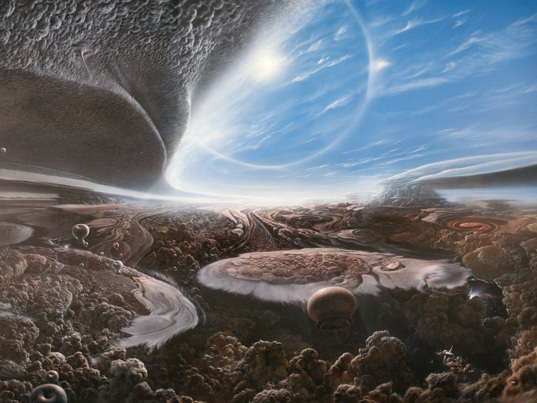
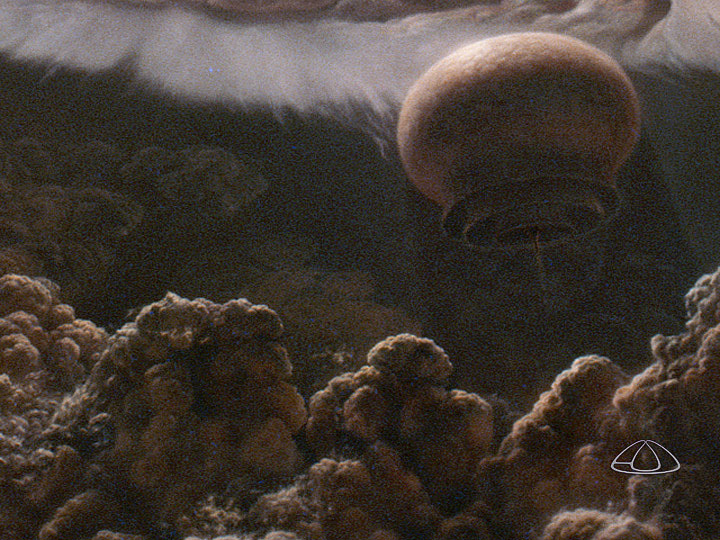
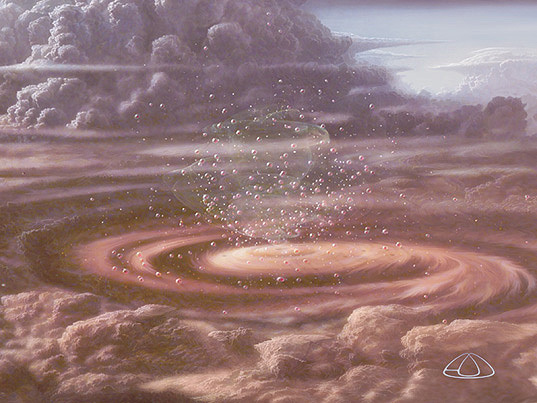
This special post is from Adolf Schaller, the creator of the painting shown below which was featured heavily in Cosmos, Episode 2, "One Voice in the Cosmic Fugue." He was kind enough to share the intense experience of creating this painting for the series back in the late 1970s.
-Casey Dreier

Hunters, Floaters, and Sinkers
Adolf Schaller
Hunters, Floaters, and Sinkers
This painting speculates about possible forms of life on a Jupiter-like gas giant. Airbrushed water-based acrylic. 90 x 120 in (7.5 x 10 ft).
Dimensions: 90 x 120 inches (7.5 x 10 feet)
Medium: Airbrushed water-based acrylic.
Construction: The HFS mural consisted of nine 30 x 40-inch illustration board panels mounted on a plywood backing. The 30 x 40-inch boards were individually worked as separate panels before mounting using a high-quality rubber cement the day before the scheduled shooting. This operation included the application of a special tape and finishing touches to conceal the seams between the panels for the sequence shooting and photography for the book.
Image scale: 1 degree of arc : 1 inch. Its angular dimensions were thus a very wide-angle 90 x 120 degree view. The choice vantage point for a viewer appreciating the entire scene was directly over the center panel some 60 inches from the surface at that point. However, no attempt was made to introduce the distortion which would accrue from mapping a wide-angle area onto a flat surface. This was done in order to permit the camera to zoom in and pan, 'truck' or travel across any region of the painting without encountering any local distortions.
In September of 1978 I received a phone call from Jon Lomberg and Carl Sagan asking me if I would be interested in working on their upcoming PBS science series, "Cosmos". Without hesitation I said yes. They asked me about working on several subjects, but one in particular held a special significance for Carl, and he was keen to see the concept treated with as much realism and scientific accuracy as possible, as well as investing it with an aesthetic that evoked a sense of wonder. He wanted it to excite the imagination, to plausibly suggest what might be within the realm of natural possibility. I shared his enthusiasm for the topic; fortunately, I had good long head start on what would become an unexpectedly daunting and difficult challenge.
It just so happened that I had been producing a series of increasingly large paintings depicting the atmospheric environments of Jovian-class or gas-giant planets - panoramic cloudscapes - for quite a number of years previously, with the intention of eventually creating a series based on hypothetical organisms and even whole ecosystems which could conceivably evolve in such habitats. These early studies included illustrations which appeared in Astronomy magazine and educational slide sets produced by Encyclopedia Britannica (from 1974-1976), Starlog and Future-Life magazines (in particular, a scene depicting a balloon probe afloat above the cloudtops of Jupiter's Great Red Spot (1977), and a 30 x 40-inch Jupiter cloudscape depicting another balloon probe I had donated to the Flandrau Planetarium in Tucson in 1977-1978.
My principle sources of inspiration came seven years earlier. On one of my regular weekend visits to my favorite library back in 1971, I came across a new arrival in the science section: a copy of the book, "Intelligent Life in the Universe", by Iosif Shklovskii as expanded by Carl Sagan, published in 1968. I was 15 at the time, and that book completely absorbed me. Their description of a biosphere entirely suspended within and supported by an atmospheric environment was my first exposure to the concept. By the time I came across Arthur C. Clarke's 1972 short story, "A Meeting with Medusa" not long after my reading of Carl's Cosmic Connection in late 1973, I was enchanted by the concept. A burgeoning ecosystem of diverse creatures inhabiting the clouds of gas-giant planets became a preoccupation, stimulating my imagination in many detailed conceptual drawings and cloudscape studies.
I had by then already developed a serious interest in astronomy and physics with the goal of obtaining a degree, but reading this book (not long after studying Darwin's "On the Origin of Species", and Sagan's "The Cosmic Connection" later on in 1973) had a powerful influence on my thinking. It gathered my varied astrophysical interests and welded them together within the context of life: the nucleosynthesis of heavy elements, biogenic conditions in the interstellar medium, planetary formation and environments conducive to prebiotic chemistry, the establishment of microbial organisms and subsequent evolution and potential elaboration of complex multicellular organisms, ecosystems, societies, intelligence, technological civilizations, and so on. I studied everything I could get my hands on dealing with the subject. I began producing paintings and was immediately published. As it transpired, with all of the commissions I soon acquired, I suddenly found myself embarked on an early professional career as an astronomical artist.
I had also begun to train myself in the use of airbrushes to more easily and effectively accomplish the delicate details and appearance of clouds with quick-drying water-based acrylic paints. Since the age of 8 I had been an avid sky-watcher, a student of meteorology as well as an amateur astronomer. I had been fascinated by clouds for as long as I can remember. (My very earliest memory is of a cumulus-filled sky brightly back-illuminated by a high sun, over a wide tree-lined park; checking with my mother, I believe the observation occurred from a baby buggy my mom was pushing me along in as we strolled along a walk lining a lake shore park on the North Side of Chicago in the Summer of 1957 when I was perhaps 16 months old. It is an extremely vivid memory indelibly etched in my mind...I have even toyed with reconstructing that scene. I might attempt it one day, but it makes me nervous: it suggests an end to memory).
In any case, I had amassed a large collection of cloud photographs for my personal reference years before I had any intention of painting clouds. In 1974 I discovered the venerable Paasche model AB extra fine-line airbrush, an airbrush whose unique mechanical design had not significantly changed since the 1930's and was used for photo-retouching and by artists working on Walt Disney's early classic animated films including 'Fantasia'. This unit became my principle tool in the creation of most of my paintings, and it was the tool I introduced to all of the members of the team of the Cosmos Artists (as we were known) in order to facilitate a uniform consistency in the painted artwork for the visual effects which we were to prepare.
A
©Adolf Schaller
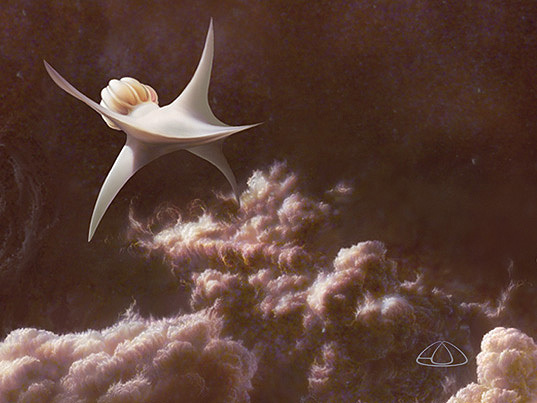
A "Floater" from Cosmos, Episode 2
Part of the larger mural, "Hunters, Floaters, and Sinkers" painted for the series.
Late that month of September, 1978, I was asked to immediately begin preparing preliminary concept drawings for what would become HFS while I was still at home in suburban Chicago. (At the same time I was also asked to begin painting a sequence consisting of four 15 x 20-inch panels depicting the final stages of our Sun's life, named by the title I gave to the first painting in the sequence, "The Last Perfect Day", which Carl subsequently altered slightly to, "The Last Good Day". That first painting was the very first of thousands of separate pieces of artwork I would contribute to the show over the better part of a year - from conventional paintings and artwork painted on flat acetate sheets for multiplane animation fx to tabletop models, planetary globes, asteroids and other models).
By the time I arrived in Los Angeles on February 13, 1979 to join the team of Cosmos Artists and work on the production of the visual effects, I had completed many dozens of preliminary concept drawings of the basic design of the HFS cloudscape environment, along with about a hundred conceptual designs for a variety of species of the three principle types which constituted the hypothetical biosphere and its ecological system: Hunters, Floaters and Sinkers - creatures with diverse shapes and anatomies, aerodynamic and buoyancy properties, propulsion mechanisms, feeding modes, social and navigation or migratory behaviors, communication, reproductive and defense and even stealth strategies, and more, that would not only fit them for life within a global atmospheric habitat, depending on conditions at various altitudes and within clouds of various composition, as well as the other dynamic aspects of weather, but also provide the basis for local or close-range interaction with other individuals of the same or different species, either in encountering those of their own kind (for reproductive purposes, or to maintain mutual proximity in gregarious social collections, for example), in encountering potential prey (Floaters grazed on diminutive but abundant Sinkers, while Hunters ambushed Sinkers for their stores of purified hydrogen as well as for nutrition), or encountered potential predators (both Floaters and Hunters could evolve elaborate defense strategies against attack by other Hunters). Carl's early speculations on Jovian atmosphere life in the 1960s had evolved and he eventually worked out the basic hunters, floaters and sinkers ecosystem which he described in a paper with Ed Salpeter: "Particles, Environments, and Possible Ecologies in the Jovian Atmosphere", which appeared in The Astrophysical Journal, Supplement Series in late 1975. Meanwhile I had been exploring the wide range of potential planetary habitats and designing a great many life-forms in the fleshed-out detail necessary for illustration, that could conceivably evolve and flourish within habitable environments, including Jovian-type atmospheres.
As I already mentioned, I had the benefit of a decent head start: I had been studying the range of potential conditions of gas giant atmospheres, considering those environments as potential habitats supporting hypothetical biological communities for years before I was called to work on Cosmos, and I had already composed a number of cloudscapes that prefigured HFS. In fact, much of the basic cloudscape is derived from the painting I donated to the Flandrau Planetarium in the spring of 1978, a work I had started on nearly 2 years before I commenced work on Cosmos that fall.
I began work on the main Cosmos VFX within several hours of my arrival. I was whisked from LAX to KCET-TV, which is located at the juncture of Hollywood and Sunset boulevards, stood around the offices for a while waiting on another team member, then off we went to the fx studio the show had contracted to perform the main fx, called Motion Pictures Incorporated (MPI) located over the Hollywood hills in Burbank to the north. The Cosmos Artists residence came to be called 'the Artists Apartment', which was actually a rented 3-bedroom house located in a relatively quiet residential neighborhood several blocks east and within walking distance of the KCET offices. We outfitted the house as an artist's studio, each of us working in their own bedrooms, or collectively in the living room/dining room on bigger projects like the large 4-foot diameter Earth globes - a surface globe prepared by Don Davis on which several of us pitched in on to help, and a separate 'cloud globe' of the same size that was my responsibility. The trip between the house to MPI in Burbank was our daily commute. That first night, returning from Burbank, and after that exhausting day that began early that morning in Chicago, I began work on HFS by preparing the first of what I thought would total at least three, but not exceed five 30x40-inch panels.
A Lazy Herd of Floaters
©Adolf Schaller
A Lazy Herd of Floaters
An updated digital restoration by Adolf Schaller of detail in his original Hunters, Floaters, Sinkers mural which appeared on Cosmos, Episode 2, which speculates about life in the atmosphere of a gas-giant planet.
That was to change drastically within the next month. The middle three panels covered the panorama centered along the horizon. I thought at first this might be sufficient, but I found that there would be many opportunities to explore the cloudscape far beneath and high above our apparent position (which I had calibrated by cloud type and other cues suggesting that the viewer was located at about the 1 bar level, assuming ideal smooth and laminar pressure gradient unaffected by weather). I had arranged for a wide-angle view with a scale of 1 Degree of arc to the inch.
It was an extremely exciting time for us: one must keep in mind this was just weeks away from the first of the Voyager flybys of Jupiter that March, and we all marveled at the awesome images Voyager had been returning of those incredible cream-in-coffee clouds with ever-increasing resolution. I was especially keen on studying them to gain some insights I could transfer into the painting. At the same time, I was preparing an accurately oblate 18-inch-diameter Jupiter model for several vfx sequences, and Voyager image prints made available to the press by JPL were indispensable references. Not every image Voyager returned was printed, however. I therefore petitioned to spend the night of closest approach at JPL so that I could study the raw images as they were displayed on the monitors.
As an aside, I should mention that we had visited JPL on several previous occasions to see Jim Blinn, who had created astonishing computer simulations of the Voyager flybys and who would be contributing a number of those along with other sequences to the show. Jim's groundbreaking work pioneered the digital fx revolution everyone enjoys in the motion picture industry today.
The computers he had at his disposal at JPL were costly, huge and slow by today's standards - it took many days for his setup to render sequences of a few minutes length. But the results were gorgeous and mesmerizing. I knew that I was seeing the future in his lab, but I never dreamed then that it would arrive as soon as it has and with such an astonishing boost of capacity and speed. Jim insisted he could never match the complex effects we were performing through traditional animation methods and camera moves on models and artwork, but it was certainly obvious to me that none of us could replicate the accuracy of the motions and trajectory of that little virtual Voyager I saw pirouetting on his monitors. Jim's sequences had the look of authenticity which was notoriously difficult to achieve via traditional vfx methods.
In any case, it was on one of those visits that I noticed there were half a dozen large monitors set up in an out of the way corner of the lobby to the von Karman auditorium, where members of the press congregated, and it occurred to me to be a perfect place to unobtrusively watch during the spacecraft's flyby. But it turned out that it was a surprisingly tough sell - nobody thought that an artist required any such referential input. This puzzling and exasperating attitude introduced me to a commonly held view amongst scientists and producers alike that art somehow springs spontaneously out of uninformed or unstimulated gray matter.
I was increasingly anxious as the flyby approached to have my request granted, so I asked to meet with Carl privately over at the Artist's Apartment. I had been enforcing a strict policy of keeping my work on the HFS panels under quarantine: nobody could see them except Carl and a few confidants on the team. The reason for this was to avoid unnecessary disruptions and preserve my concentration against the well-intentioned suggestions and advice of people. (I liken the phenomenon to rearranging the furniture physically without being able to visualize whether a given configuration is optimum: if it was up to some, a given project would change course so often it would never get done. The execution of a work is not a time to get distracted by experiment - that's supposed to be settled with the preliminary conceptual studies).
To my delight, I got my chance to plead my case: Carl accepted my invitation to stop by about a week before the flyby, and I displayed the three central panels arrayed along the horizon, propped up against the wall side-by-side, to show him how it was progressing. By that time I had finished most of the areas within 8 to 16 inches of the horizon centerline and had roughed out the rest of the cloudscape throughout the remaining area of the panels.
I was very gratified at Carl's reaction to it - he spent several long silent minutes in front of the panels, slowly shifting from one side to the other, his eyes scanning the detail along the horizon and the structures I had established above and below it. When he began to speak he grew really excited and I fielded his questions the best I could. I showed him what I had begun to prepare in two additional panels that could be positioned at the upper left and lower right corners to give the camera a view of regions close up, far down below and high overhead, where much of the details of the organisms that I had sketched could be established. I ventured the possibility of adding two more panels beneath and above the center panel as well, reiterated that the amount of work involved in covering so much area on these boards with a uniform level of detail was very time-consuming and laborious, and that the schedule may not permit me to get that far to finish those. He stood in front of the scene and stepped back a few paces as if to take in the entire scene in his imagination, while pondering silently for another full minute. Then he said, "Let's fill out the whole thing and make it a full nine panels."
My initial elation at his reaction to the painting turned to stark terror. I remember a very unpleasant queasy feeling in the pit of my stomach as my mind automatically calculated the area involved and I guess I was at a momentary loss for words. (10,800 square inches - 75 square feet of area to cover with millimeter resolution detail - it was petrifying). I finally managed to croak out something about how I didn't have enough time to devote to something that large and keep up my responsibilities with the rest of the effects. He simply said "Don't worry, we'll find a way", and just like that the matter was decided.
A Hunter
©Adolf Schaller
A Hunter
A speculative hunter animal evolved in the atmosphere of a gas-giant planet. Developed for Cosmos, Episode 2.
I must have been showing my shock, because he cheerfully changed the subject onto my request to go to JPL for the Voyager flyby. He reiterated the fact that he didn't want HFS to reflect an explicit association with Jupiter. I said I understood that perfectly that it was to be a portrayal of a hypothetical but generic gas giant world. But it was nevertheless an important opportunity to gain an insight into gas giant atmospheres. After all, Jupiter is a gas giant planet - and nobody had ever seen what those clouds really look like at the sub-km resolution that Voyager would soon return. I considered it vitally important to the painting, and I said so. It really is that important if an artist is expected to realize a visualization with maximum realism and accuracy. (It is generally under-appreciated that the task of portrayal compels artists to explicitly define the subject - we can't always enjoy the luxury of ambiguity in dealing with our subjects). I added that those monitors around the side of the auditorium lobby were all I wanted to be able to sit in front of so I could sketch and take notes. He smiled and nodded and said, "Good! I'll arrange it!" And with that our meeting ended.
So I was there at JPL during the flyby. As full of people as the auditorium was, that corner was deserted and eerily quiet all that night. But I didn't pay much attention to that. My eyes and attention were glued to the monitors and I was soaking in every image that came up. It was a mesmerizing night; it was as if my mind was transported to the spacecraft. The memory of it often returns to haunt me in quiet moments to this day...and, yes, it contributed a great deal - in some places crucially - to HFS. The main insight that was impressed on me that night was the prevalence of vortices and eddies, as especially evident in the turbulent region downstream of the GRS, and in the interactions between ovals and along the boundaries between bands and zones, right down to the limit of resolution. In suitably turbulent regions, vortices and eddies were evident down to the limit of resolution. That was the single most important insight I derived. It suggests the preponderance of vortices below mesocyclone scale, and the vigorous convection evident in many regions is more than sufficient implication: Jupiter and many other gas giant worlds with deep convective atmospheres must be full of tornadoes at every scale from the monstrous down to whirlwinds.
One consequence of the insight on the mural appeared in the form of a large cyclone reddened by a high population density of "Sinkers" (the analogue of plankton in earth's oceans) concentrated there to exploit nutrients updrafted from the depths below. Sinkers are comparatively tiny, ranging from microbial to large party balloons in size (many of the larger examples ranging upwards toward weather-balloon-size being newborn and juvenile Floaters and Hunters), so we only see the reddish coloration of the vortex from a distance of a few hundred kilometers, but their presence is also indicated by what they have attracted: a congregation of "Floaters" lazily grazing on them or giving birth to them in great numbers over the spot, in a vaguely helical pattern resembling the molecule of life. Strong convection and turbulence in Jovian atmospheres is often cited as a detriment to the evolution of organisms within them, yet such cyclones can conceivably play a crucially important role in concentrating nutrients and provide stable refuges.
I also added a more conventionally recognizable 'twister' emerging out from the ceiling of the canopy at the upper left because I wanted to give the camera a chance to come across one unobstructed funnel, and there was no other convenient place to place it. Its bothered me because strong vertical convection of the sort typically required to form them would normally not be taking place within a laminar stratus plume of that kind. It was placed there for the convenience of the shoot: it wouldn't be very noticeable in the long shots, but only when the camera panned over the region at close quarters, making the ceiling resemble the base of a convective cell.
I spent an estimated average of 4 hours of our typical 14-hour day on it every day over the following 7 or 8 months. Some days it was difficult to find a half hour for it - on those days I was too exhausted from pressing duties elsewhere in the fx production. To my dismay that workload had increased apace with the added challenge of filling out nine entire panels for HFS. The docket was exhausting.
I don't recall what month HFS was finally ready for the shoot. (I was far too exhausted by then to notice and, frankly, the Southern California climate doesn't provide one who grew up in the upper Midwest and used to annual snowfall enough cues to impress what season it might be...but I think it had neared the end of 1979 by the time I had finished HFS for the shoot). I do remember that the final push was a 2-week period staying permanently awake, like a zombie. It's like sleepwalking, except that though you know (or think you know) you are awake and your eyes are open, you are in a constant dreaming state. It was dreadful. I don't remember anything I painted during those closing weeks except for flashes of the final touch-ups on the stage at KCET. But I do remember it took me a very long time to recover.
The sequence was shot with director Adrian Malone having Carl physically walking, speaking and gesturing in front of it. Adrian meticulously choreographed the camera moves that panned over and zoomed into sections of the mural to show some of the detail in it with Carl's narrative voice-over. I was not present at the shoot: I was passed out in bed in our new apartment in Santa Monica, not remembering how I got there. I think I was out for almost 3 days. After HFS there were odds and ends as the work load rapidly eased off. It was the last major artwork or fx sequence of the production. It was rescheduled that way to help give me all the time possible (I'm pretty sure, under Carl's instructions) but it was The Monster among monsters.
Later the next year after Cosmos had aired, I and my fellow vfx colleagues (belonging to both the Cosmos Artists team and the crew who worked at Magicam noteworthy for their excellent Alexandrian Library and the Cosmic Calendar sequences) were awarded the 1980 Prime-Time Emmy Award for Outstanding Individual Achievement, Creative Technical Crafts. We assembled up on the stage and accepted the award to a long ovation. To my consternation my colleagues kept ushering me forward toward the dais to make the first comments. I was reluctant - I'm not good at speaking, let alone publicly. All I could manage was to thank my parents and a special friend for their support. But the one person who inspired me to explore the possibilities more than any other was Carl Sagan.
Source : http://www.planetary.org/blogs/guest-blogs/2013/20131023-on-hunters-floaters-and-sinkers-from-cosmos.html

lundi 15 septembre 2014

Des subdivisions administratives

Article de Theo Calderon

Voici quelques idées destinées à donner un peu d'épaisseur et de cohérence à ces secteurs et zones galactiques décrits un peu succinctement dans les Encyclopédies Galactiques. Commentaires et remarques sont les bienvenus.

Un District Galactique est un cube de 10.000 années-lumière de côté. Il y a 100 Districts Galactiques, identifiés par un chiffre romain. Le Ier District est celui abritant Prima, le IIème District celui situé à l'Est galactique du Ier, le IIIème celui situé au Sud galactique du IIème, et ainsi de suite dans le sens horaire.

Image

Allez hop, le secteur 412/39 est rebaptisé XXXième District Galactique.


Un Secteur Galactique n'a pas de taille définie, mais c'est au minimum un volume d'espace cubique de 1.000 années-lumière de côté, contenu à l'intérieur d'un District Galactique. On y trouve plusieurs types d'espaces territoriaux aux statuts juridiques différents :

Baronnie Impériale

C'est un ensemble de systèmes planétaires tous placés sous la tutelle d'un membre de la noblesse locale, représentant de l'autorité impériale. Selon les cas, il porte le titre de Baron, Vice-Roi, Lord, Siridar ou Connatic, en fonction de l'héritage historique du secteur. Par exemple, le Baron Anthon de la Fiertayade dans le Secteur Gandalf, Sa Grâce le Baron Drugan Malevoy de Kerzut dans le Secteur du Trèfle, Lord Valentin de Majipoor dans le secteur éponyme.
Les systèmes qui composent une Baronnie abritent :


  • des mondes de niveau galactique NT6 (ex : Vonda, Tréfolia, Mandrake, Terra Formata, etc...).
  • des colonies de peuplement en cours d'écoformation (NT5 ou 6 selon l'ingénierie planétaire requise) et des colonies d'exploitation minière ou agricole (ex : Kharg NT5), ou encore des planètes de villégiature (ex : Prénuptia). Ces mondes peuvent parfois être habités par une civilisation autochtone NT1 parquée dans des réserves. Ils dépendent généralement de la métropole impériale NT6 la plus proche qui finance leur développement et délègue un Gouverneur Général pour l'administrer.
  • des mondes abritant des civilisations autochtones NT2 et NT3, placés en quarantaine par le Bureau des Affaires Indigènes, dont l'Empire attend le développement autonome et l'accès au NT4 pour les intégrer à la société galactique.
  • des planètes-bagnes (ex : Cerbère NT2) ainsi que parfois des mondes placés sous Restriction Technologique (NT3 ou NT4) par mesure de rétorsion politique (à cause d'éléments non contrôlés s'opposant aux autorités impériales).
Chaque monde de la Baronnie est libre d'adopter son propre système de gouvernement. Un nombre variable de Conseillers Planétaires dépendant du poids démographique de la planète est désigné (par vote ou par nomination) pour la représenter à l'Assemblée Sectorielle. Les membres de l'Assemblée Sectorielle choisissent (élisent ou nomment) à leur tour les Délégués qui vont siéger à la Chambre des Pairs sur Prima.

Protectorat Impérial

C'est un ensemble de systèmes planétaires, des unités politiques rattachées à l'Empire par des traités de défense, des accords économiques privilégiés, mais sans avoir intégré encore celui-ci. Les autorités gouvernementales du Protectorat envoient également des Délégués à la Chambre des Pairs, mais s'ils peuvent participer aux débats, ils n'ont pas le droit de voter les résolutions.

Provinces Souveraines

Il s'agit d'entités politiques distinctes de l'Empire, commerçant éventuellement avec lui, mais disposant de leurs propres forces de défense (ex : l'Alliance des Douze Soleils, la Confédération de l'Amas de Gion, la République du Cygne, la Coalition des Mondes Agrippins, les Territoires Kiffish). Ils peuvent envoyer des observateurs à la Chambre des Pairs, mais ils ne peuvent prendre part aux débats (ceux enregistrés au Journal Officiel...) que s'ils y ont été autorisés par décision du Premier Orateur de la Chambre, généralement à l'issue de grandes manoeuvres diplomatiques.

Systèmes Extérieurs

Il s'agit de mondes indépendants, qui ne sont rattachés à aucune des entités politiques de leur Secteur Galactique, de niveaux technologiques très disparates (ex : Brénus, Estébois, Jonction, Tortuga). Leurs seules relations avec le reste de l'Empire (quand ils en ont) sont de nature commerciale.

Source : http://www.encyclopedie-galactique.com/viewtopic.php?f=5&t=1861