Affichage des articles dont le libellé est biologie. Afficher tous les articles

samedi 11 juin 2022

"Le rorqual bleu se nourrit de krill." - dicton populaire impérial


Le plus gigantesque animal qu'ait jamais abrité la planète Terre est le rorqual bleu (ou baleine bleue). Sa longueur moyenne est de 25 à 27 m pour un poids de 130 tonnes, mais elle peut dépasser les 31 mètres de longueur et 170 tonnes.

Contrairement aux rorquals communs et aux rorquals à bosse qui diversifient leur alimentation entre du poisson et des invertébrés comme le krill, les rorquals bleus ne se nourrissent pratiquement que de krill, un petit crustacé mesurant entre 2 et 5 cm.

 Archives de l'Ancienne Terre - Encyclopédie de la Toile


Monnaie et taxe de l'Empire galactique

Le Système Universel de Crédit (SUC) s'est imposé dans toute la galaxie.

Dès son plus jeune âge, chaque citoyen de l'Empire Galactique se fait greffer dans le petit doigt de la main gauche un circuit intégré miniaturisé : cette micro-puce est dès lors capable de gérer entièrement la fortune de son possesseur. Elle crédite ses gains et débite ses pertes, effectue les paiements ponctuels ainsi que les prélèvements réguliers, loyer, remboursement de prêts, locations diverses, etc.

La monnaie impériale étant entièrement dématérialisée, et sous contrôle de la Banque Impériale de Crédit (BIC), toutes les transactions monétaires sont informatisées. Il suffit alors d'associer une routine informatique à chaque transaction pour que l'Admintek de l'Empire Galactique prélève automatiquement une taxe sur ces transactions.

Cette unique taxe impériale se porte à 0,1% de chaque transaction effectuée en crédits impériaux. Il n'existe aucun autre impôt. Et cela couvre absolument toutes les dépenses étatiques de l'Empire !

Ce qui fait dire aux contribuables que "la baleine" (l'Empire Galactique) se nourrit de "krill", c'est-à-dire d'une taxe minuscule et exclusivement de celle-ci. A noter que le rapport de 1 pour 1000 (0,1%) est exactement celui entre la taille du krill et celle du rorqual bleu.  

Illustrations

Le rorqual bleu en train d'avaler un banc de krills.
 
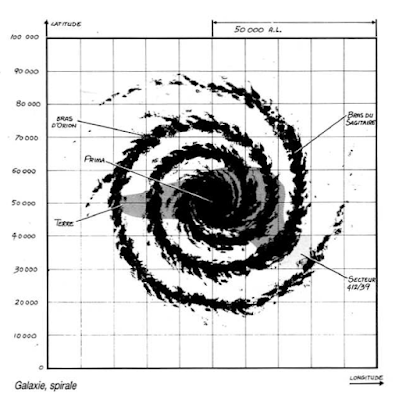
L'Empire Galactique, en gris, dont la forme évoquait jadis celle du cétacé bouche grande ouverte 
 

Sources d'inspiration :

https://calypso1577.blogspot.com/2016/11/monnaie-de-lempire-galactique.html 

https://calypso1577.blogspot.com/2021/11/la-creation-monetaire-dans-lempire.html

http://justemonopinion-jeronimo.blogspot.com/2018/12/simon-thorpe-vers-un-monde-pratiquement.html

lundi 25 juillet 2016

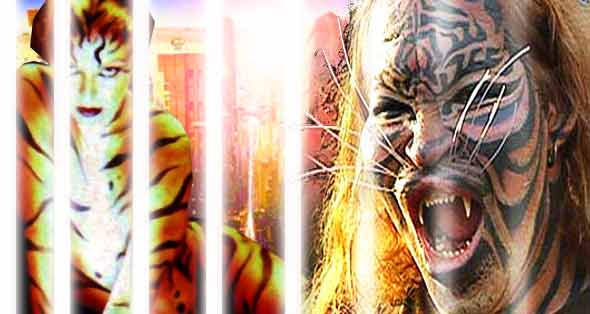
Tiger Splices

Popular human bodyform

Tiger Splices
Image from Bernd Helfert

Many different clades of nearbaseline human are colloquially known as 'tiger splices' but in fact most of these are actually carnivorous rianths, humans with a small amount of tiger genome or with completely artificial neogen genes added to give a tiger-like appearance and other characteristics.

Actual tiger 'splices', that is to say tigers with a small admixture of human or neogen genes that give them some human-like characteristics, are much less common, as are tiger provolves, which are fully sophont tigers which have few human characteristics or none at all.

Sourcehttp://www.orionsarm.com/eg-article/4e8e6d05253af

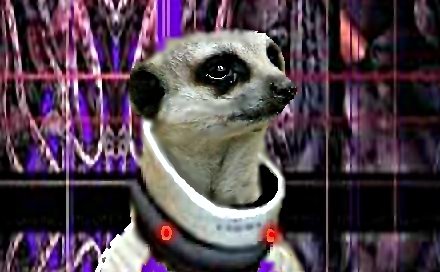
Tavi, Clade

Provolved clade largely derived from meerkats

Vacationers at JD345768502-7
Image from PortalHunter
A group of Tavis on vacation with their Faber associates on JD345768502-7

The Tavi are a provolve/splice group of Terragen mammalian stock. Genetic analysis shows that the clade is derived primarily from the meerkats (Suricata suricatta) of Old Earth, but with significant additions of genetic material from other mongoose species, from humans, and from procyonids (raccoon, coati and kinkajou), as well as some strictly neogen sources. Tavi are rare in the Inner Sphere, but are well known on the Periphery of the Terragen sphere as early colonizers of new systems. They have been particularly common in the regions just beyond NoCoZo influence.

Physically, the Tavi are small slender humanoids. Standing digitigrade they are typically under 1.5 metres tall. They have clawed hands, prehensile tails, short snouts and large brown eyes with vertical pupils. Their black skin is covered in short greyish-brown fur over most of the body, but shows through near the hands, face, and feet. The fur itself varies from dense to sparse according to the ambient temperature over the past few weeks. Tavi prefer a high protein diet containing some chitin for roughage (comparable to their ancestral diet of lizards and small arthropods), but can subsist on a wide range of organics. They have a highly developed tactile sense and a surprisingly strong grip, and have a deft and delicate touch with intricate work. Though not particularly large or strong, they have very quick reflexes and are swift sprinters. They are excellent climbers and leapers, and are good at wriggling through confined spaces. They have a very keen and wide-ranging sense of smell. Tavi vision and hearing are somewhat comparable to that of the upper end for human nearbaselines subclades, with visual acuity and colour discrimination well above the human baseline norm and extra sensitivity to faint sounds. However their night vision is better due to their vertical pupils and the upper range of their hearing is higher by two full octaves. Their own language consists of high pitched chirps, barks, and trills, but their vocal range is very broad and they can communicate verbally with most terragen bionts.

All Tavi can grow or shed under-fur to adapt to the ambient temperature, and are able to see clearly in very dim to very bright light. They are capable of regenerating limbs without technical support and have a moderate degree of resistance to gamma and particle radiation and are strongly resistant to UV burns. Though they prefer habitats in the 25 to 35 °C range with a terran-standard mix of gases and standard terran gravity, they can tolerate varying temperatures in a broad range of oxygen bearing atmospheres, and they can survive indefinitely in anything from microgravity up to two terran gravities. Under adverse conditions Tavi are capable of placing themselves in long-term hibernation, reducing food and oxygen consumption to negligible levels. On the whole, they are physically tough and versatile creatures.

Living without medical support, Tavi have a natural life span of just under a century, though of course in civilized areas they can defer aging effects indefinitely. Their childhoods are short (sexually mature at 8 years, socially mature at 12), and they bear litters of 2 to 6 children at 6 month intervals. This gives the clade a powerful natural reproductive potential. However, socially subordinate individuals are not fertile, and when crowded or otherwise in sub-optimal conditions even the alpha pair in a Tavi social group does not bear any young.

Tavi are adaptable and imaginative, and have a strong sense of curiosity. They are quick and flexible though not particularly deep thinkers, and though they learn very quickly they have a very practical outlook and relatively short attention spans. Though individually they are not considered to be particularly intelligent overall (about the level of a baseline human), each one usually has one or more islands of brilliance (linguistics, programming, art, gene splicing, habitat design, combat, teaching, etc.). Their diverse talents and the fact that they are highly cooperative within their social groups makes them quite formidable collectively even if they are not very imposing as individuals. Tavi intuitions, innovations and kludges are famous. Tavi have a high need for excitement, and are aggressive both individually and as groups, though seldom to the point of physical violence. Even though their responses to their environment are quick and spontaneous, they are not usually long sustained. Though seldom actually rash or cowardly, Tavi are easily irritated or frightened by comparison with a typical human nearbaseline.

There are no known transapient entities of Tavi derivation. Since the Kedric Incident, most Tavi who attempt artificial self-improvement are regarded with extreme suspicion by the rest of the clade. Tavi have few lasting prejudices beside this, other than their present-day distrust of SI:2 entities. However, they are excitable and prone to political, legal and territorial disputes. They are good tacticians but poor strategists, and so are more often than not the losers in long term campaigns against patient or numerous opponents. Many sophonts regard them as clownish and bumptious half-provolved beings. Even where well-liked (some human nearbaselines think of them as "cute", especially in their heavily-furred cold weather form), they are not often highly regarded by a typical unsophisticated modosophonts.

The basic Tavi social unit is the "mob": an alpha male and female with 6 to 30 subsidiary non-reproducing adults, usually related, plus any children. The children are raised in community crèches. The subsidiary adults may, on occasion, divorce their mob and petition another group for entry, or may leave to form a new mob of their own. This most commonly happens between the ages of eight and fifteen, but adults of any age have been may do so at any time. More rarely, a displaced alpha pair will leave the primary mob with a few faithful hangers-on. Mobs cooperate as often as they compete, and occasionally form temporary nation-like, semi-democratic structures based partly on a hierarchy according to economic power and partly on one-mob-one-vote referenda. Where there are few immediate opportunities, a Tavi mob may remain stable for centuries. However, when a frontier opens up, mobs fragment and replicate as individuals and small groups strike out on their own and found new mobs. At times, the population growth rate can be alarmingly rapid.

Tavi
Image from Steve Bowers

The Tavi are most often found at or beyond the fringes of Terragen civilization, where their alertness, innovation, and ability to deal with crises are most valuable. Scouting, exploration, and crisis management are areas in which they particularly excel. They typically discover and colonize a star system, terraform planets and construct habitats, and live there for several generations before a combination of Tavi restlessness and competition with later-arriving clades causes the majority to move on and colonize new areas (not before, of course, they have sold their existing holdings at a profit). Those who remain tend to be found in the "outback" of habitable planets, or on the less developed fringes of a system. Some Tavi mobs in the more highly settled areas are reclamation specialists who complete botched or marginal terraforming, fix damaged habitats, or clear systems that have been mined with the less sophisticated blights from autowars. In such cases, they tend to use the space they have created for a few generations, and then either by contract or impelled by pressure from later immigrants, sell their holdings and move on. A few collections of Tavi mobs have been "kept" in societums in the Utopia Sphere, but they are a difficult clade to maintain in this way, as they cannot thrive without new challenges and frontiers. Despite their reputation for simplicity, they can recognize attempts to manufacture artificial challenges for them.

Tavi mobs are commonly found in association with reprogroups of the vec clade Faber. Together the two clades can cover a wider range of habitats when they develop a new system, and in alliance, they are far more formidable when they deal with other clades than either of them might be individually, since their personalities and skills are complementary. Some Tavi mobs have integrated themselves into the Deeper Covenant, primarily in their specialty of colonization and reclamation. Together with Fabers they are often the first scouts and constructors for the beamrider network.

The precise origin of the Tavi is unknown. Their own records are of little use, as most mobs have a low regard for historical data unless some practical value is evident. The first mobs were recorded in the 5th millennium in the Utopia Sphere, but they quickly spread from that region, and the Utopia sphere may or may not have been their origin. Tavi are not particularly associated with any of the known Archailect driven civilizations, or allied with any of the major polities. It is commonly believed, even by the few speculative Tavi, that the entire clade was specifically designed to prepare new systems for Terragen settlement. Sapient grade conspiracy theorists often add that the Kedric Incident was designed to propel them even more quickly to the Periphery, so as to speed this process.

One of the few remains of the common Tavi heritage is a stylized crest with the motto "run and find out" in ancient Anglic. Such a motto, in one form or another, is known by nearly every known culture of the clade. The derivation of this appears to be a single tale by an Industrial Age fabulist named Kipling. This is the most likely clue as to the author(s) of the Tavi and their own culture, but no plausible candidates have yet emerged.

Sourcehttp://www.orionsarm.com/eg-article/47f6e514ba394

Sufants

Genetically Engineered Sophont Elephants

Jessi and Mahotep
Image from Arik
Jessi, a nearbaseline human, dancing with Mahotep, a Sufant.

A program of genetic engineering of elephants began in the mid-third century AT by a consortium of companies from Sri Lanka and Thailand who wished to improve the working Asian elephants already present in their countries. Already being intelligent, the provolution of elephants did not prove too hard a task, limited mainly by the slow reproductive and generation cycle of the elephant species.

However in 350 A.T. they successfully engineered the 'Superphant', which was more intelligent than an unmodified Asian elephant, with a more dextrous trunk and some limited ability to speak. Superphant was quickly contracted to Sufant, the name all of the various elephant provolve races have been known by ever since.

They were a great success in their jobs, and even came to replace mechanical vehicles in some roles, particularly in rough country. Because of this success, the Sufants spread to other places, particularly India and other south-east-Asian countries. As the success of the project grew, the first Pan-Sophontism movements began to grow up, particularly in Sri Lanka. The Sufants were one of the earlier provolved sophont races, being perhaps the fifth or sixth such race (records are unclear).

Later generations of Sufants were made more intelligent yet, up to the human level, and it was here that problems began to arise. The Sufants tended to still have contact with unmodified elephants in their work, but the more intelligent they became, the less and less well the modified and unmodified elephants got on. The difference in intelligence was simply too great, leading to a number of fatal fights between individuals and small groups of Sufants and normal elephants, with a great deal of collateral damage as these multi-tonne-mass creatures brawled in the street.

To solve this problem, most governments simply decreed that the Sufants and normal elephants be segregated from one another. However, the Sri Lankan government came to a different conclusion. Influenced by the Pan-Sophontism movement growing in their country, they instead decreed that all elephants in Sri Lanka be provolved into Sufants, with the new intelligent species to be given full equality with the humans there.

In time the idea of equality for Sufants spread, and all members of the species everywhere came to be granted citizenship of their various nations, though, in some cases, not without struggle and deaths. But eventually Sufants came to live peacefully side-by-side with humans across Asia, with all of Sri Lanka's elephants now being a sentient race, one more flavour in that nation's cultural melting pot.

As the Sufant race developed, with their permission additional changes were made to them, increasing the dexterity and number of fingers of their trunks, and also increasing the number of trunks, normally to two (sometimes side by side, sometimes one on the top lip of the Sufants, one on the bottom lip), but in a few cases to four, or even six. In all cases efforts were made to ensure that all Sufants remained inter-fertile.

While the Sufant race was spreading in Asia, efforts to provolve African elephants were also being made by a group of African nations led by the government of Kenya. This was inspired by the success of the Sufants, and also revived an old idea as to how useful tame or sentient African elephants could be to the development of the continent.

However, although as intelligent as the Asian variety, African elephants proved a much harder species to provolve. Not only did they not have the thousands of years of association with humanity 'hard-wired' into them which the Asian species possessed, but they also simply did not seem to like humans, regardless of all the efforts made to change this. They seemed, as a race, to hold a grudge against humanity as a whole, perhaps for the long-term hunting of their kind for ivory by humans.

Despite this, a small group of sophont African elephants was produced, and given a reserve on which to live while their future was considered. They came to look down their noses (quite an impressive thing, with an elephant) at the Sufants, considering them far too friendly with humanity. The Sufants, in their turn, and after a number of heated meetings with representatives of the African provolves, also came to look down on the African provolves as ignorant half-savages who should stay on their reserve, and away from humanity.

By the time of the Technocalypse, Sufants were well established across Asia, and in a few other parts of the world too. Experiments in creating lazurogenic mammoths were also taking place, with the intention of, perhaps, creating a cold-adapted Sufant. The small enclave of provolved African elephants also still existed, having been rather ignored, perhaps in the hope that it would simply go away. However, very few provolved elephants of any kind had been into space, mainly because of their size and difficulty of manoeuvring in micro-gravity.

The Technocalypse nearly caused the extinction of all of the various elephant provolve races. It is almost certain that the African provolves did become extinct during the Grey Spring of 541 AT, though they were later recreated by the GAIA archailect. As with all of the other sophonts of Earth, after GAIA took charge the Sufants and African provolves were given the choice of staying on Earth and living in an eco-friendly manner, or leaving. All of the African provolves and a few of the Sufants remained on Earth; most of the Sufants left.

In due course the Technocalypse was overcome and stability returned, and the Sufants diversified even further, some setting up polities of their own, and some living side by side with the other sophont races.

The diversification of the Sufants included the creation of lazurogenic mammoth, mastodon and deinotherium-types, which have all became distinct sub-species, as have a number of pygmy Sufant types. Using bionanotech to strengthen their bones and other tissues also led to some Sufant groups becoming gigantic, the largest Terragen-descended land animals ever to exist. These various original groups of Sufants have since diversified into a number of sub-clades, each containing mixtures of different features such as origin (Asian elephant, Indian elephant or lazurogenic mammoth, mastodon or deinotherium), size, and number of trunks. Some Suphants have also been given a prehensile tail so that they have manipulative ability at both ends of their body. Certain other types of Suphant refer to this sub-group by the derogatory term 'Monkeyphants'.

Almost all elephants and Sufants have a unique seismic sense, the ability to both receive and transmit infrasonic seismic signals through the ground, allowing them to sense activity, and communicate with other Sufants and elephants at great distances. They can also use their seismic sense to detect vibrations and so on in objects they touch.

None of the elephant provolves proved to particularly like living on starships or in space habitats, apparently because of the limitations such places put on their seismic sense, and the impression they gain from this sense of their living over a great void. Because of this, the only large elephant provolve settlements grew up on planetary surfaces.

Some space-going Sufant groups did have their seismic sense removed to make their lives there easier. Most other Sufants look down on them much as a human might on someone who voluntarily plucked out their own eyes. Other space-going groups have simply adjusted their brains so they do not react so negatively to what their seismic sense detects in space. Some space-going Sufants have also adjusted themselves to existence in microgravity, with prehensile feet and so on; many of these now do not greatly resemble baseline elephants.

It was some time after the Gaian Whales left Earth that a similar Diaspora of Earth-based elephant provolves began. These proved to consist entirely of African elephant provolves, who wanted nothing to do with any other race. Their ships departed into interstellar space after only minimal contact with anyone else. A few of these provolves settled on the world Hhrraiirah in Sophic League space, but most of them are still heading to rimward, presumably hoping to escape the Terragen Sphere altogether.

In the millennia since, the Sufants have spread far and wide through Terragens space. Expansion into space has occasionally brought various Terragens-descended groups into contact with African-descended Sufant groups who have settled on various previously unexplored worlds. These groups usually pack up and leave when outsiders make contact with them. Because of this behaviour it is suspected that there are also a number of Hider Sufant groups. African Sufant polities have, on a number of occasions, warred with human and other groups, particularly Indian-descended Sufants (who they disparagingly refer to as 'Baba's, after an ancient fable), apparently still bearing their ancient grudge.

There have been, and are, a number of Sufant polities spread across Terragens space. Most of these are fairly small in influence, partly because their large size tends to lead to their worlds having small populations (a maximum of hundreds of millions on an Earth-like world, with little room for other large herbivores) and also because they tend to be limited to large savannah, forest or tundra-type habitats. Because of their seismic sense, few Sufant polities use space habitats of any kind, and what space vessels they have tend to be very solid hollowed out of asteroids with living quarters installed inside. However, a few Sufant groups are spacefaring and a number are heavily cyborged and bioborged. Many Sufant ships have seismic communication systems.

Biont Encoding Protocol
Image from Steve Bowers

One of the most successful of the Sufant sub-clades is the Harrroh descended from Indian elephants, who are respected as philosophers, playwrights and artists. However, there are many other clades of sufant which are found throughout the Terragen Sphere.

The Hhrraiirah, in the Sophic League, are descended from the African elephants who left Earth later, and have established a quite competitive culture that puts them rather at odds with most of the rest of the League.

Many Sufant groups have world-deity-based religious beliefs based on their seismic sense, which, to them, allows the world talk to them, and the world allows them to talk to others at great distances. Those Sufant groups who are non-technological and/or primitive (whether from choice or otherwise) often take these beliefs much more seriously than high-technology groups. Some Sufant worlds have implemented computer networks, and in particular BioGeoComputer systems, such that it and they can communicate via the ground, using their seismic sense.

The various Sufant races have also, over time, produced their share of higher toposophic entities.

Unmodified elephants walk at a pace of perhaps four miles per hour, but can charge at speeds of up to thirty miles per hour. They cannot jump and so cannot pass barriers too wide or too high to step over, but they can swim well. They are surprisingly graceful, and can be remarkably stealthy for such large creatures. All of these capabilities are retained in most Sufants.

The social structure of Prim and Ludd Sufant groups is often not unlike those of unmodified elephants. Male and female Sufants in such societies tend to live in separate groups (herds).

The female herd is the much more enduring social group, and is the basis of Sufant society. These herds (which also include any children) are led by a matriarch, the 'keeper of the memory', the oldest and most experienced of the herd, who guides the herd - her family, generally consisting of her female offspring and their young, though it can also include one of the matriarch's sisters and her offspring as well - and protects them from danger, using the wisdom she has acquired over the years. These groups tend to be between ten and twenty individuals, but can split up pr merge depending on the size of the family, the amount of available food, and how well they are getting along. Female groups that split up maintain contact with one another, forming a wider society, and with links to other groups form clans, which are even larger social units.

When the matriarch of a herd dies or otherwise steps down from her position, one of the oldest of her offspring takes her place. Without leadership unmodified elephants become unhappy and disorientated; although Sufants can cope better with this, they are still uncomfortable if they are in a leaderless group. However, because they are sophont they normally have a defined line of succession so that, even if medical treatment is not available, it would take a major disaster to render a herd entirely leaderless.

Male (bachelor) herds tend to be much more nomadic and transitory than the female herds. As male Sufants grow older and approach puberty they gradually become more independent from the family group, spending more time on its outskirts. Eventually, the males leave the family and join with other males of different ages in a bachelor herd.

In general the male and female herds remain apart, only coming together when females are in heat, when a male will pursue a female until she accepts him (or chases him off), mate, and then return to the bachelor herd.

More advanced Sufants will have societies which are based on this social structure, but usually have a thick layer of civilisation overlaying the basic society making it, in many cases, barely recognisable as deriving from baseline elephant society. And with the diversification of the Sufant clade into a superclade there are now, as with all superclades, countless different tribes, subclades, species, cultures, lineages, and so on which vary greatly among themselves in social and other matters.

In many advanced Sufant societies herd leadership is provided by AIs, or by Sufants who have ascended to higher toposophic levels. In some cases this has also allowed the creation of 'super-herds' where one AI or post-Sufant leads not just one herd but many, co-ordinating them together into a very well organised Sufant polity. In other cases, biont-friendly hyperturings have adopted Sufants, and even entire worlds of Sufants, in the same way as they have been known to do with hu and other bionts. On a few worlds the use of implanted communications and web nodes has led to Sufant herds self-organising, not into a group mind (though that has happened in some cases) but into larger and larger clans and beyond this into a society which, although still made up of individuals, acts almost automatically as a single social unit, co-ordinated by their communications web.

All Sufants have an even longer period of childhood than unmodified elephants, becoming sexually mature at around sixteen years of age, and are usually considered fully mature when the male Sufants join the bachelor herds, usually at around twenty-five years of age.

Sufant greetings can be very loud and raucous affairs, as the Sufants, with their heads held high and ears flapping, fill the air with a symphony of trumpets, rumbles, screams, and roars. They take play, joy and grief very seriously.

One thing that has become clear over the centuries is that Sufants have long memories, and they bear a grudge. This was even observed in unmodified African elephants, which have been known to hunt down and kill lion cubs when lions kill their young. Although they are aware that not all of a given group will necessarily be responsible for a given act against them, they will do their best to track down those who act against them, and both gain retribution and ensure that such acts do not happen again. They will not act precipitously in this, but they will, eventually, act. There are several recorded instances of Sufants transcending simply to give them the power to act against some threat to them or their world, and even more of Sufants carrying vendettas over many generations.

Most baseline Sufants also seem to have a near-instinctive negative reaction to big cats, which also applies to provolves, rianths, and splices with big cat characteristics. Those Sufants who have not had this outmoded behaviour edited out of their minds usually have rather strained diplomatic relations with these various cat-like races.

Source : http://www.orionsarm.com/eg-article/47f6d64d4d6bd

Siberoo

Zoosplice Provolve sophont clade based on synthesis of Siberian tiger and red kangaroo

Rantreleka, a Siberoo joey
Image from Darren Ryding
Rantreleka - a Siberoo Joey

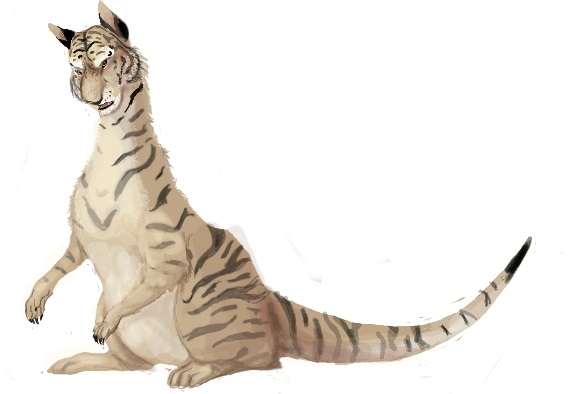
The Siberoo is a zoosplice/provolve species first developed in 280 AT; originally a barely sapient combination of Siberian tiger and red kangaroo, with small traces of polar bear and Alaskan malamute.

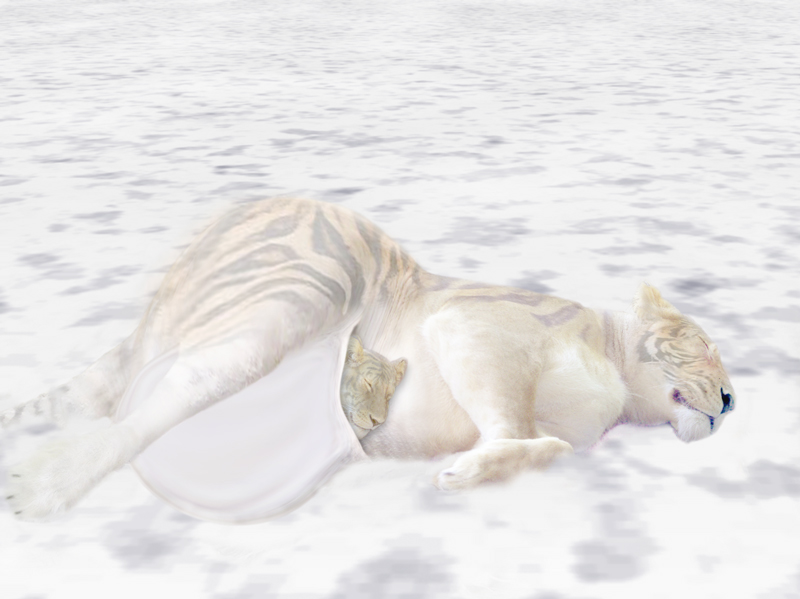
Right from the start, Siberoos were gifted with extraordinarily sharp senses; their hearing, smell and night vision were the equal of any "natural" mammal. Early uses of the Siberoo were in the polar regions of Earth, where they were trained to sniff out humans trapped under snow or ice, and dig them out with their extremely powerful and dexterous paws. The massive female marsupials were invaluable, since they could carry snow victims back to base and keep them warm at the same time. The superior speed and agility of the males made them essential for search-and-rescue operations; yet these qualities were more than complemented by the females’ sheer robustness, stamina and carrying capacity.

Siberoo (drawing)
Image from Lectabat

The average female was stoutly built, weighing from 1.5 to 2 metric tons at a height of 3.6 metres, with a maximum pouch capacity of over 200 kilograms. The smaller, leaner male averaged 300 kilograms at 2.7 metres high. This obvious dimorphism led many humans of the time to refer to the two sexes as "jeeps and tanks". While both males and females ran in long, powerful strides (like bipedal dinosaurs), both were also capable of leaping extraordinary distances when necessary. The males far more frequently utilized this latter ability.

A fraction of the females at any given time were reserved for breeding purposes, while the rest kept their pouches vacant for passengers or rescue victims. Most females, however, would become both rescuers and breeders within the course of their lifetimes. A healthy, well-fed female was impervious to even the most violent snowstorm. Almost any pouch passenger would have been equally invulnerable, separated from the freezing air by thick layers of hide, fat and fur, enclosed by a muscular opening that — as with many natural marsupials — was potentially watertight.

Siberoo Passenger
Image from Darren Ryding

Even the early Siberoos were intelligent enough to search for snow victims without the help of a rider. Adults developed a verbal recognition vocabulary equivalent to an average eight-year-old baseline human. This enabled them to follow specific verbal directions, read signs, use various tools for self-grooming and cleaning, and even enjoy motion pictures during their time off. The occasional use of vocalizer implants made human/Siberoo communication even broader (though not without occasional confusion). To compensate for whatever they lacked, many Siberoos carried turingrade accessories and sensory enhancers while on duty, while human riders were often seen on specially designed saddles for the Siberoos' sloping backs.

Indesigen, the superbright-led multinational corporation responsible for creating and nurturing the Siberoo species (among others), generated some ingenious marketing campaigns to finance the care and breeding of Siberoos. These ranged from Siberoo rides for tourists in snowy regions to sales of sculptures, posters, plush toys, virtual characters and other merchandise. One early arctic tourism advertisement began with a close-up of a woman apparently wearing a fur-lined Inuit hood. The point-of-view zoomed out to reveal that the fur around her head was really the pouch opening of a Siberoo. This advertisement alone is considered largely responsible for a sharp spike in arctic tourism. At this stage, Indesigen was already extending their considerable provolution budget to many Siberoos, for reasons both practical and sentimental. By 420 AT some fully sapient, speaking Siberoos occupied executive positions in polar research bases and tourist resorts. Their full support of further provolution ensured the exponential rise of sapient Siberoos over the following century. A noteworthy percentage of Siberoos who immigrated to slightly warmer regions became active in art and entertainment, particularly male virch sculptor Hieronymous Frost and action/adventure actress Fluffy Steele.

The popularity of these majestic beasts was so huge that, during the 330’s AT, there was a disturbing trend in which tourists would deliberately get themselves lost in the snow just to be rescued by a Siberoo. Evidently, they seemed to ignore the fact that they could get a Siberoo ride for a little more money and a little less bodily trauma.

It was one of history’s great ironies that the most famous Siberoo of this era was not one of flesh and blood, but every bit as self-aware. It was the virch aioid Selena, who played a nightclub-singing superheroine in the hugely popular virch series Arctic City. Many of her fans were actual Siberoos, who saw her as a positive (if bizarre) role model. Selena’s stylized, anthropomorphic features contrasted sharply with the more natural feline characteristics of "real" Siberoos. The contrast became most apparent when she made virtual contact with her Siberoo fans.

Thousands of Siberoos (mostly provolved) were evacuated from Earth during the Technocalypseof the late interplanetary era. In the millenia that followed, the great majority of Siberoos possessed intelligence well into the nearbaseline range, with a minority becoming superbright and (more rarely) transapient. The Siberoos on the frozen planet of Kragliath eventually gengineered themselves into the (mostly isolationist) Megasibers; sauropod-sized, four legged felinoids with backward facing pouches, extremely dexterous tails and exceptionally thick layers of hide and blubber.

Siberoo
Image from Darren Ryding

Many baseline Siberoos continued to happily perform their original function on small, frigid planetary colonies, while others spread throughout the Terragen Sphere, finding work and companionship in a wide variety of fields. It is estimated that tens of millions of baseline Siberoos (and more from derivative clades) live within the Terragen Sphere today, particularly in the NoCoZo, Utopia Sphere and Zoeific Biopolity.

Siberoo religions, though varied, are largely goddess-oriented due to the sheer size and dominance of the females, as well as the very clear memories of living in a female's pouch. While their political philosophies are even more varied, the most common thread involves a sense of rugged individualism for most of the time combined with community spirit in special situations. This balanced combination of individualism and altruism is largely influenced by the Siberoos' marsupial life cycle.

skalosak recharging armour
Image from Darren Ryding

Many Siberoos tend to be fond of combat sports, and even joeys often enjoy one-on-one wrestling matches. However, due to the ethics of fair play and mutual respect that they are taught from an early age, young Siberoos avoid wrestling matches with the opposite sex during early adolescence, when the females rapidly begin to outgrow the males. Bullying a weaker individual — especially one of another species — is considered a low and cowardly act and the perpetrator is typically ostracized.

It is rumoured that the newly transcended Zoeific godling Halatajah was once a Siberoo; however, this has not been confirmed.

Sourcehttp://www.orionsarm.com/eg-article/47f6c8411e3c4

vendredi 22 juillet 2016

Neo-Pigs

Important and influential porcine provolve species

Neopig

In the first century AT it was discovered that pigs, even domesticated ones, were very intelligent animals, in some respects more intelligent even than chimpanzees. However, as they were largely considered to be nothing more than food animals, little interest was paid to this discovery.

Later, in the first century AT some genetic engineering was carried out on pigs, modifying certain types to be biologically compatible with humans, allowing the transplanting of pig organs into humans (xenotransplantation).

Further genetic engineering of pigs was carried out in the late first and early second centuries AT for various reasons, often to do with increasing meat production. The most radical of these modifications was by French truffle farmers, seeking to make a better truffle-hunter. They engineered their pigs with a vastly enhanced sense of smell, taste and touch, housed in a multi-tentacled nose, rather like that of a star-nosed mole, giving a vastly enhanced ability to rummage for truffles and other food. These changes were made at the cost of some visual acuity, but also included some brain enhancements to allow the pigs handle the new sensory inputs.

When chimps and dogs were provolved, some people suggested that the same might be done to pigs. The only problem with this idea were the many objections raised by people who wondered how sentient versions of food animals would consider those who both made them sentient, and who used to farm them for their meat.

Pigs were provolved in 350 AT, at least according to records kept by the pigs themselves. Many records were lost or distorted during and after the Technocalypse period, but it is possible the pigs' claims are correct.

Unlike provolved Chimps and Dolphins, the NeoPigs were not created by a public body of some kind, but instead by the Onion Hunters, a group apparently inspired by the Cult of the Exsanguinated Giraffe and using information gained from the Feynman Expert System to perform sophisticated bioengineering pranks. Their NeoPigs (as they came to be known) were based on the already-modified truffle-hunter pigs as their genetic code was already mapped in detail from the previous modifications made to them.

In many ways pigs were easier to provolve than dolphins, as there was greater mental similarity between pigs and humans than dolphins and humans. Likewise, fewer physical changes were required, giving the NeoPigs primate-based linguistic mental structures, including some empathy genes to allow them to work better in large groups (normal wild pigs living in small family groups of one male and several females) and modifying their voice-boxes to enable them to speak. Other changes included restoring the pigs eyesight (requiring some additional brain enhancement over their intelligence gain) and modifying their nose-tentacles to give them effectively a multitude of small manipulative trunks in two clusters, one on each side of the snout, rather like a prehensile moustache, while retaining their enhanced senses of smell, taste and touch. Their eyes were also modified to allow them to focus close to themselves without losing distance vision, and their ears made somewhat smaller and more erect (rather like those of wild boar) so as not to obstruct their eyes.

Although it is assumed that the Onion Hunters created some of the NeoPigs while they developed their genetic code, the first the world at large knew of them was when their genetic code was posted on the BioGeneticsDot datasphere site. And of course, some people grew some of them from the uploaded genetic data. Even now the identity of the Onion Hunters remains a mystery, although some evidence points to a Russian origin.

At first the NeoPigs were curiosities, and often simply pets, treated differently in different places depending on local attitudes and laws. They displayed a pragmatic and even-tempered outlook on life, with the ability to be very focused on things, but also adaptable, and with a well-developed sense of humour. As their numbers grew, the well-developed sense of smell of the NeoPigs found them work in environment maintenance, medicine, contraband control, police work and a number of similar fields. Their government roles were assisted by the fact that an adult NeoPig can be very large, quite as large as a normal pig, and just as strong.

When the existence of NeoPigs became known to the world at large, a number of religious groups - with a majority of Jewish and Muslim groups, including ones who had otherwise condoned genetic engineering - called for them, and their creators, to be utterly exterminated as abominations. However, despite the killing of a number of NeoPigs and their owners/creators around the world and solar system, the wide and free availability of the NeoPig genetic code, and the fact that anti-NeoPig feeling was by no means widespread, caused this idea to not become widespread, and the NeoPig species survived this crisis.

The NeoPigs have never shown any great dislike for humanity despite their past oppression, and despite the best efforts of certain SapientChimp groups to encourage this. Instead they show a high degree of pragmatism. They learn from the past, and take precautions for the future, but do not let the past control them as they consider to be the case for many SapientChimps and Enhanced Dolphins. However, they often have pet humans.

NeoPigs were never specifically legislated for or against, but simply became an accepted part of sophont society.

In time they expanded out into space with humanity, SapientChimps and Enhanced Dolphins. However, their lack of hands rather limited their ability to operate in microgravity, causing their population to be concentrated in the habitats with spin gravity. As such they were badly affected by the coming of the nanite swarms, their population reduced to those NeoPigs living a small number of outer-system habitats.

With the post-technocalypse recovery, NeoPig populations increased, and the species began to grow and spread again, going out to the stars with the space rush of the First Federation, and settling a number of mixed and NeoPig-only colony worlds.

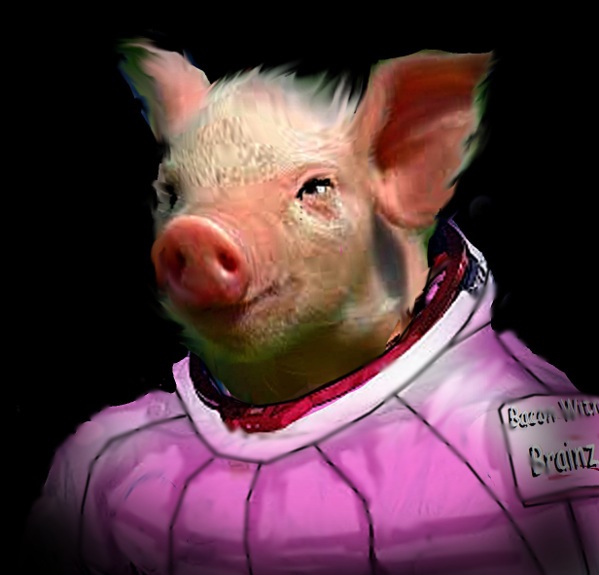
Neopig in spacesuit
Image from Steve Bowers
Over time the NeoPigs have spread through Terragens space and diversified into quite as many clades as the Enhanced Dolphins and SapientChimps, some of which bear almost no resemblance to their original forms. At the present time there are several dozen small NeoPig-descended polities scattered across Terragens space, as well as populations living in all areas of explored space.

Over the millennia there have been a number of Superbright NeoPig clades, and, usually arising from these, various NeoPig transcends. Some of these rule some of the NeoPig polities across Terragens space.

Some SuperBright NeoPigs, operating from a desire to help their non-provolved brethren have, over time, organised the provolving of a number of species with a close evolutionary relationship to pigs (similar to man with the great apes), including wild boar, warthogs, peccaries, and so on.

NeoPig habitats are often rather difficult for a more humanoid being to cope with. This mainly stems from their being built for horizontal rather than vertical creatures, and the use of scent markers rather than visual signals for many things.

In terms of personality, NeoPigs are pragmatic, even-tempered, focused, adaptable and have a good sense of humour. They are usually reasonably placid, too. However, they can become aggressive during the mating season, and females can in particular be aggressive when protecting their young.

In terms of appearance, 'baseline' NeoPigs are at first glance much like the non-sapient domestic variety. However, they have larger heads, and particularly large, almost human-like foreheads. Their ears are somewhat smaller, and the hips of female NeoPigs are rather larger than the non-sapient variety, to allow the birth of larger-headed young. The number of young born in a litter is also rather smaller than the unmodified pig, usually being around two, rather than six. Male NeoPigs often have large tusks, which they decorate in a variety of ways, often with carving or inlay. The most obvious difference from an unmodified pig are the two clusters of manipulative and sensing tentacles on each side of the snout, giving NeoPigs of both sexes what are effectively long prehensile moustaches. Male NeoPigs can grow up to two hundred kilos in weight, with females being smaller, up to roughly one hundred and fifty kilos. Some NeoPigs have modified themselves to have a much more wild boar-like appearance.

neopig
Image from Bernd Helfert

Most NeoPigs, being furless, usually wear clothes in inclement conditions.

NeoPig family groups tend to consist of one male and several females. In prosperous NeoPig groups females tend to have their own 'nesting rooms' where they go after the birth of their piglets. In other NeoPig groups there are community 'nesting hostels', or, indeed, the females simply eject the male while there are young piglets present.

Young adult NeoPigs are usually ejected from the family unit. As such most NeoPig communities have hostels for them to live in as they adjust and start to make their own way in life.

Sourcehttp://www.orionsarm.com/eg-article/47f42ca0dce4d

samedi 18 juin 2016

Bioborg

Bioborgs are among the most varied of phyles, and may adopt a wide range of forms and sizes. Here a female Sritht is shown next to a typical nearbaseline human for comparison

Bioborgs are humans, animals, or other lifeforms, heavily modified via biocircuitry, biomachinery, biosymbers, bionano, wetware, etc (collectively: bioware). No inorganic components (other than some occasional support or reinforcing structures) are used at all for any of these augmentations. The reason for this may be aesthetic, ideological, cultural, religious, or pragmatic. Bioware mods may range from simple skin-patches to complete reorganising of skeletal, muscular, nervous, digestive, and/or pulmonatory systems. Sometimes the modifications are so subtle that on the surface the bioborg looks just like an ordinary baseline or nearbaseline of its original species. At other times they are so radical as to make the original genomorph of the bioborg indeterminable.

The advantage of using organic mods are obvious. The mod becomes part of the individual's body, is holistically and integrally a part of the same body and chi-energy system. Neo-taoists, yogis, athletes, holistic healers, and a number of martial arts schools, all prefer bioware over cyberware for just such chi-integration purposes. The biomod is maintained in the same way as any other organic component. Instead of an external power source, ordinary food provides fuel, just as it does to the rest of the body. The increase in food-intake naturally differs according to the size, purpose, efficiency, activity and metabolism of the implant; anywhere from negligible to an entire order of magnitude (thus some unwitting bioborgers end up having to have their entire alimentary system redone to cope with the increased requirements of digestion; often this ends up far exceeding in expense and discomfort the initial augment).


Although good quality bioware should adapt themselves to any host body, this is rarely the case in practice. More often a course of medical nano, immunosupressants, and pheno-gengineering are necessary to modify the host so it doesn't reject the implant. Eventually the implant should acquire the hosts own genetic signature. Depending on the size, nature, and quality of the mod this may take anywhere from only a few hours to a period of days, weeks, or at most several months. There is also the task of adjusting to the new mod via physiotherapy, training, and wetware.

Bioware can be used for almost anything inorganic cyberware can. There are biocomputers, biobatteries, bio-remotes, even biolasers which use special light-producing and light conducting bionanogenic cells. A lot of bioware, such as ch'i-batteries, body gestalts, erotogens, pheromones, etc , have no hylotech equivalent. However, bioware suffers from a lack of modularity, and it is usually fairly traumatic to the body to remove or insert a piece of bioware; unlike drytech which can be done as easily as unplugging the old unit and replacing it with the new.

Bioware is most often used by biocentrist empires and polities like the Zoeific Bioplity and the ill-fated Softbots and Biovirate, Houses like the Genen and the Stevens, and various biosupremist and anthropist groups. It is also very popular among Fomac traders, Erotogini, Gothics of various persuasions, heterodox rianths, a large number of provolve species, and many other important cultures and subcultures.

vendredi 17 juin 2016

Les Exilés

de Schattenbogen le Lun 13 Oct 2014

Petites réflexions personnelles.

Pour ma part, j'ai tendance à voir l'Empire Galactique  comme un endroit "positif".
La vie n'y est pas rose (surtout du côté des planètes NT 3/4), mais il y a une réelle volonté de rendre l'endroit aussi agréable que possible pour le plus grand nombre et si ce n'est pas encore le cas, c'est en tous cas la tendance qui domine.
Or, problème récurrent avec toutes les sociétés utopiques, l'absence de conflits peut amener à une stagnation.
Ceci est tout autant un problème de société dont les hautes instances de l'Empire ont sûrement conscience, qu'un problème pour les MJs ("maîtres de jeu").
L'existence d'un problème extérieur peut être un moteur de tensions, source de progrès et de changements, comme source d'aventures.

Les Exilés

1) On arrête pas le progrès.
2) L'espace est grand pour celui qui veut s'y cacher.

Quels que soient les efforts déployés par l'Empire et ses guildes, rien ne peut totalement empêcher les partisans d'une science évoluée de s'exiler pour continuer à pratiquer des arts que l'Empire réprouve, que ce soit la Bio-Ingénierie ("Dune", cf. Bene Tleilax) ou encore la Robotique/Nano-technologie ("Dune", cf. Ixien).

Bien que pourchassés par l'Empire au travers de l'Armée, de la Loge Tekno ou encore de la Guilde Navyborg, bien que repoussés en permanence par l'expansion permanente de l'Empire, ces branches désormais indépendantes de l'histoire impériale continuent à suivre leurs cours, à se développer et à se ramifier à leur tour.
Un jour, elles pourraient aussi chercher à revenir au Bercail.

La Bordure

Il existe une limite mouvante au-delà de laquelle la loi de l'Empire n'a pas cours (cf "Santiago", "Le Faiseur de Veuves" de M. Resnick).
De l'autre côté, ce que l'on appelle volontiers la "Bordure" ou la "Frontière", est le refuge des hors-la-loi, de tous ceux qui ne veulent pas accepter les limitations de l'empire ou le mode de vie trop civilisé de celui-ci.
C'est un endroit chaotique, où la force domine souvent la loi, mais où la notion de liberté prime avant tout.
L'Empire délègue volontiers le travail qu'elle doit y mener aux Libres'Affs et autres chasseurs de primes.

Forces et faiblesses des Exilés

Biophiles

Avantages :
- Accès à la technologie du clonage et de bio-ingénierie du corps qui rend la colonisation planétaire plus facile.
- Accès aux armements biologiques qui peuvent localement se révéler dévastateurs.
- Possibilité de créer des organismes spécialisés, capables même d'infiltrer discrètement l'Empire et/ou posséder de forts pouvoirs psys.

Désavantages :
- Grosse difficulté à garder une identité commune due à la rapide diversification des lignées.
- Stagnation de la technologie standard.
- Risque de lignées stériles/inadaptées pour cause de spécialisation excessive.

Mécaphiles (parfois écrit Mechaphiles)

Probable que le point de départ est un mélange IA/robots/cyborgs/humains qui va se simplifier en cyborgs/robots.
Très probable que les deux branches se scindent pour incompatibilité sur le point de vue de la présence ou non de tissus vivants.
Grosse tendance psychotique des Cyborgs (mais si cela ne les tuent pas, apparition de cyborgs capable de pleinement intégrer leur nature double biomécanique).

Avantages :
- Optimisation des ressources (nano-technologie aidant) et logique des décisions.
- Faible valeur accordée à l'individu.
- Peu/pas de besoins et de limitations biologiques.
- Possibilité de multiplier les canaux de communications hyperondes et de créer un réseau.
- Possibilité de créer des essaims capable de ratisser les systèmes rencontrés de toutes leurs ressources pour agrandir l'essaim.
- Croissance exponentielle à l'aide de technologies Von Neumann.
- Peu gêné par les phénomènes de dilatation temporelle. Si un réseau existe, celui-ci est déjà dans son propre espace temporel.

Désavantages :
- Dans le cas des robots, pas d'accès au Triche-Lumière.
- Peu/pas de pouvoirs psys et de solutions intuitives (élément merdique, donc humain).
- Nano-risques.

À noter que les Vaisseaux Varlets, s'ils sont particulièrement maniables, ne pourraient utiliser leur armement principal qu'en réglage "coque".

Ceux de la Bordure

Avantages :
- Arrivage permanent de nouveaux individus.
- Pas de système central de gouvernement.
- Possibilité de talents spéciaux.
- Il y aura toujours une Bordure.

Désavantages :
- Pas de système de production et de recherche à grande échelle, dépend largement de l'Empire.
- Pas de système central de gouvernement.

Sourcehttp://www.encyclopedie-galactique.com/viewtopic.php?f=6&t=1924

vendredi 12 juin 2015

Symbiose orque-algue sur Kombâ et métamorphose plant'humaine sur Venceslas

L'espèce humaine a essaimé dans la Galaxie plus que toute autre espèce astropérégrine contemporaine. Son instabilité génétique s'est avéré un outil d'adaptation bien utile pour compenser les imperfections du long et difficile processus de terraformation.

De monde en monde, de colonisation en colonisation, de mutations en mutations, les humains se sont différenciés. On parle tantôt de races (différences morphologiques), tantôt de sous-espèces (quand on approche du seuil de non-interfécondation).

Quelques exemples de races ou sous-espèces. Les "homo sapiens" de la Terre ne possédaient pas de pouvoirs psychiques. Puis sont arrivés les premiers "mutants" de l'Âge de l'atome, les "homo superior" dotés d'une grande diversité de pouvoirs (télépathes,  passe-murailles ...) qui se répandront grâce à leur admission au sein de la République Galactique. On notera aussi l'émergence de para-humains : "homo robustus" (d'apparence orcoïde), "homo pilosis" (d'apparence naine), "homo nobilis" (d'apparence elfique), etc.

Outre ces généralités, il est intéressant de connaître des particularités planétaires, pour certains groupes restés isolés, involontairement (comme les Âgons, descendants d'une armée perdue) ou volontairement (comme les Boii, des nomades interstellaires, sédentarisés sur une planète végétale).


Les Âgons : orcoïdes de la planète Kombâ.

Dans les mers et océans de l'Ancienne Terre, de nombreux coraux vivaient en symbiose avec des végétaux unicellulaires : les zooxanthelles dans les mers chaudes, ou d'autres espèces de phytoplancton dans les mers froides. Un large éventail de bactéries fixatrices d'azote, y compris des décomposeurs de chitine vivaient dans le mucus produit par les polypes et formaient une part importante de la nutrition des polypes. Le type d'association entre le corail et sa flore variait selon l'espèce. Différentes populations bactériennes étaient associées aux muqueuses, au squelette et aux tissus des coraux.
Ainsi en va-t-il des Âgons, ces para-humains de la planète Kombâ. Leur histoire commence lors du Kralizec, cette guerre galactique qui suivit l'effondrement de l'Empire de Leto II. Pendant des siècles, les mondes humains se livrèrent une guerre colossale jusqu'à ce qu'un autre Empereur, Osiris, impose son autorité en réunissant les mondes saints et sains. Les Âgons formaient une légion orcoïde. Privée de commandement à la fin de la guerre galactique, cette légion se perdit sur un monde très éloigné de la Centralité et s'installa dans ses jungles.

Les Âgons tirent leur couleur verte ou brune de la zooxanthelle, ou plus simplement xanthelle, (algue du genre Symbiodinium). C'est une algue unicellulaire, pouvant vivre en symbiose avec leur porteur; jadis, sur l'Ancienne Terre, avec le corail, mais aussi avec les bénitiers, ainsi qu'avec de nombreuses espèces de méduses scyphozoaires, comme le genre Cassiopea ou Cotylorhiza par exemple, et chez d'autres animaux marins (HydrozoairesLimaces de merradiolairesciliéesporifèresactinies...). Dans les couches superficielles des mers chaudes, dépourvues de la base de la chaîne alimentaire marine qu'est le plancton, les zooxanthelles se développent en absorbant le dioxyde de carbone libéré par les coraux (ou un autre animal hôte) et fournissent en retour divers nutriments à leur hôte.
Chez les coraux durs bâtisseurs de récif (Scléractiniaires ou Madréporaires) et chez certains Actiniaires, Corallimorphaires, Zoanthaires et Octocoralliaires (Alcyonacea et Gorgonacea) l’endoderme des polypes renferme, sans exception, des algues unicellulaires. 

Les Âgons se reconnaissent par tribu grâce à leur xanthelle symbiotique. Les xanthelles tirent bénéfice des porteurs accueillants que constituent les orcoïdes, dans le monde hostile possédant son propre écosystème, et fournissent aux Âgons des nutriments bien utiles quand on découvre quels dangers il faut surmonter pour se nourrir de prédation et de cueillette sur Kombâ.

Les Boii, hommes-plantes de la planète Venceslas
Les nomades boii n'ont pas survécu en résistant à la planète où ils se sont installés. Ils ont survécu en se fondant dans la planète, en l'absorbant jusque dans leurs gênes. Leur adaptation évoque celle d'un être vivant déjà connu depuis l'Ancienne Terre.

L’élysie émeraude (Elysia chlorotica) est une espèce de limace de mer, un gastéropode opisthobranche marin.
Cette limace de mer ressemble à un nudibranche, mais n'appartient pas à ce sous-ordre de gastéropodes. C'est en fait un membre d'un sous-ordre voisin, les sacoglosses.
L'élysie émeraude est le premier animal découvert capable de réaliser la photosynthèse dans des chloroplastes « volés » (kleptoplastie) à une algue dont elle se nourrit ; elle peut ainsi vivre jusqu'à dix mois grâce à la seule lumière du jour, sans autre apport nutritif.
Cette limace de mer littorale utilise des chloroplastes de l'algue hétéroconte Vaucheria litorea pour produire une grande partie de l'énergie dont elle a besoin. E. chlorotica acquiert les chloroplastes en mangeant cette algue et les stocke dans les cellules qui tapissent son intestin; ces chloroplastes fournissent à leur hôte les produits de la photosynthèse. Bien que les chloroplastes survivent pendant toute la durée de vie du mollusque (environ 10 mois), ils ne sont pas transférés à sa descendance.
Puisque l'ADN chloroplastique code seulement 10 % des protéines nécessaires à une photosynthèse fonctionnelle, les scientifiques ont recherché dans le génome de E. chlorotica des gènes permettant la photosynthèse et la survie des chloroplastes. Ils ont trouvé un gène d'algue, psbO (un gène nucléaire codant une protéine à manganèse stabilisatrice à l'intérieur du photosystème II5) dans l'ADN de la limace de mer, identique à la version algale. Ils en ont conclu que le gène avait probablement été acquis par un transfert horizontal de gènes, puisqu'il est déjà présent dans les œufs et dans les cellules germinales de E. chlorotica.

En absorbant, selon le même processus que ces élysies émeraudes, des gènes végétaux, les humains du peuple Boii sont devenus de véritables hommes-plantes (plant'hommes) capables de survivre par photosynthèse sur ce monde très particulier qu'est Venceslas :
- un noyau rocheux de petite taille : le socle, 
- une forêt pétrifiée : les colonnes, 
- une forêt basse composée d'une immense variété de champignons n'ayant pas besoin de lumière, 
- et la forêt haute où vivent les plant'hommes et où circulent les fragrances qui font la renommée de ce monde.