lundi 17 novembre 2014

Le space opera d'après le cafard cosmique (http://www.cafardcosmique.com/Le-Space-Opera)

Voyages interstellaires, vaisseaux galactiques grands comme des montagnes, planètes lointaines couvertes de sable ou de neige, héros brave et extra-terrestres impitoyable... voici quelques éléments du space opera tel qu’il est né après la Première Guerre Mondiale, aux Etats-Unis.
Mais depuis, le space-op’ a fait du chemin et se révèle comme l’un des genres les plus ambitieux de ces dix dernières années...


Règle n°1 : le Space Opera, c’est... spatieux

Ce qui compte dans le Space Op, c’est de prévoir grand. Pas question que l’action se situe dans un mouchoir de poche : le Space Op exige au minimum un Empire de proportion galactique, et des centaines de centaines de centaines de planètes.
Prévoyez des planètes mono-décor : planète des glaces, planète des mers, planète désertique, planète jungle, bref de belles planètes identifiables [faudraitt pas que le lecteur s’y perde quand même] qui offrent de beaux paysages. A l’idéal, dessinez une carte en annexe, ça fait toujours plaisir et ça fait plus « vrai ».
De même, les batailles spatiales impliquent à tout le moins plusieurs milliers de vaisseaux de tous format. Faut que ça fuse, que ça vaporise, qe ça désintègre. Donnez leur des noms d’insectes, ça fonctionne bien. N’oubliez pas, bien sûr, quelques vaisseaux mères gigantissimes pour organiser le massacre.
Bref : il faut faire du spectacle, ne mégotons pas sur la quantité. Et n’oubliez pas : vous n’aurez pas vraiment à construire le décor. Tout est dans la tête, alors n’ayez pas peur de faire grand, c’est le même prix.

Règle n°2 : le Space Opera, c’est... en couleur !

La vie est trop courte pour s’habiller triste : dans le Space Op, la mode est en pleine forme. Variez les costumes, faites valser les chapeaux, oser toutes les audaces. Opposez des indigènes boueux en peaux de Schmurk, des dignitaires religieux en robes bariolées et des autocrates couverts de bijoux.
Attention : dans le Space Op, l’habit fait le moine :
  • habillé trop riche = personnage puissant mais véreux
  • habillé sobrement = personnage moral et droit [sauf s’il est en noir, là ça craint].
Les filles peuvent s’habiller court, surtout si elles sont copines avec le Héros, car alors elles sont bombesques. Rappelez-vous que dans le futur, les jolies filles seront toutes en bikini. On arrête pas le progrès.
N’oubliez pas enfin une bonne pelleté d’extra-terrestres. Ca semble évident, mais ça va mieux en le disant. A poil, à plumes et à vapeur, ils seront disponibles en toutes tailles, parfois drôle, parfois effrayant, le maître mot est diversité.
Chaque race de E.T. aura d’ailleurs sa culture, ses mœurs bizarres et ses lubies exotiques. Il faut faire riche, foisonnant, un vrai carnaval.
Que ce ne soit pas crédible ne doit pas vous freiner [cf. Règle n°3]. Lâchez votre imagination, le lecteur a acheté votre bouquin pour ça !

Règle n°3 : le Space Opera, n’est pas euclidien

S’il y a bien quelque chose qui importe peu dans le Space Op, ce sont les lois de la physique. La gravité, on s’assoit dessus. La vitesse de la lumière, c’est dépassé. Le paradoxe temporel, on oublie. Le Space Op doit être avant tout spectaculaire, alors ce qui gêne, on jette.
Tant pis si dans l’espace le son n’existe pas : c’est bien plus sympa les réacteurs nucléaires qui vrombissent et les lasers qui sifflent.
Réfléchissez bien : cette façon de voir n’a que des avantages ! Plus besoin d’essayer de comprendre la « Théorie de la Relativité » pour avoir l’air crédible face à Gregory BENFORD ouStephen BAXTER.
Deux ou trois termes pseudo-techniques sortis de votre imagination, [comme « meta-quantique » par exemple] et hop ! le lecteur ne se rendra compte de rien. Au contraire, il sera ravi ! Et si vous avez besoin d’une invention miracle pour sauver le scénario en perdition, foncez !

Règle n°4 : le Space Opera, ne se prend pas la tête !

Ce n’est pas pour rien que l’on parle souvent du Space Opera comme d’un Western dans lequel l’espace aurait remplacé le Far West : le genre réclame des Héros avec un grand H, et des Vilains avec un grand V. Et un combat final où gagne... devinez qui ?
LE HEROS
Ne faites pas dans la demi-mesure : le Héros est gentil, il n’a peur de rien, et puis c’est bien normal vu que de toutes façon il est beau et de lignée aristocratique. Il peut être accompagné d’acolytes sympas mais pourvus de défauts. Un ou deux défauts, pas trop quand même. Ca aidera le scénario, et ça rendra le Héros encore plus... héroïque. Et puis un mec si sympa a forcément des amis.
LE VILAIN
Il est très très très méchant. Et si possible moche à faire peur. Il est puissant [on croirait presqu’il va gagner !], il est impitoyable. Il est conscient de sa méchanceté, mais il s’en fiche : c’est dire s’il est méchant !
On peut distinguer deux carrières de Méchants :
- le Méchant qui fut gentil dans le passé, voire même qui a un lien de parenté et/ou d’amitié avec le Héros. C’est bien, ça fait tragédie grecque [une tragédie grecque, c’est un space opera en sandales qui pourrait se dérouler à Sparte]. Au moment du dénouement, le Méchant se repentit. Ca vous fait une fin morale. Mais il meurt quand même, parce qu’il a fauté, et qu’il faut pas déconner.
- le Méchant qui est en fait une incarnation du Mal. Dans ce cas, on découvre en cours de récit qu’il y a un Encore Plus Méchant caché derrière, une entité puissante et satanique qui tire les ficelles. Le Diable, à côté, c’est un chic type. Le dénouement passe donc par l’anéantissement total du Méchant [Enfin, total, jusqu’au tome 2]. Ca vous fait une fin à grand spectacle.
L’INTRIGUE
Elle doit tenir en quelques mots : le Vilain fait des misères au Héros, il marque même quelques points contre lui, et au moment où l’on pensait le Héros perdu, paf ! à la surprise générale des enfants de moins de 6 ans, en fait il s’en sort. Héroïquement cela va de soi.
Cependant, attention : simple ne veut pas dire simpliste ! Trop de manichéisme tue le suspense. Prévoir donc quelques traîtrises bien lâches et un retournement de veste spectaculaire, qui permettront de faire rebondir l’action de votre Space Op, le rendront sympathique aux critiques, et fourniront la matière de post enthousiastes sur le Forum du Cafard cosmique.
EXEMPLE : «  Tiens, tiens, on dirait bien que l’Empereur Zhakggg et son épouse viennent nous lancer un ultimatum...  »


Les Auteurs de Space Opera

Intrigues simplistes, batailles galactiques, extra-terrestres vilains tout plein, les auteurs des pulps américains des années 1920 à 1950 ne faisaient pas dans la dentelle. Mais attention : tout n’est pas à jeter.
C’est de façon méchamment ironique que plus tard, en 1941, Wilson TUCKER baptise space opera [sur le modèle de soap opera, les feuilletons sentimentaux sponsorisés par les marques de lessive] ces romans sans profondeur qui privilégiaient le dépaysement et l’action. Le terme a longtemps gardé une connotation franchement péjorative.
Il est vrai que les auteurs américains de SF cherchaient davantage à divertir leurs lecteurs qu’à les faire réfléchir. La fierté nationale des Etats-Unis après la victoire de 1918 leur donner ce ton triomphant :reflets de la puissance américaine, les Empires galactiques qu’ils mettent en scène écrasent leurs ennemis extra-terrestres avec l’assurance d’incarner le Bien. Ils poursuivent la conquête de l’Ouest dans les espaces stellaires. D’ailleurs, certaines intrigues des premiers space op’ sont le décalque des intrigues déjà utilisées dans les pulps spécialisés Western !
JPEG - 2.5 ko
E.E. SMITH
Edgar Rice BURROUGHS et E.E « Doc » SMITH sont les créateur du genre. Edward Elmer SMITH est le premier à avoir situé ses intrigues au cœur de la galaxie. Tout devenait possible ! SMITH est également le premier a avoir développé un cycle sur plusieurs romans. De 1928 à 1954, sa série Fulgur s’est étendue sur 7 volumes, publiés en feuilleton par Astounding Stories.
Ses deux séries phares sont :
- La Série Skylark : La curée des astres ["The Skylark Of Space", 1928], collection "Rayon Fantastique" et trois autres volumes, inédits en français.
- La Série Fulgur [éditions Albin Michel] :
  • « Triplanétaire » [« Triplanetary », 1934]
  • « Le premier fulgur » [« First lensman », 1950]
  • « Patrouille galactique » [« Galactic patrol », 1937]
  • « Le fulgur gris » [« Gray lensman », 1939]
  • « Le surfulgur » [« Second stage lensman », 1941]
  • « Les enfants du joyau » [« Children of the lens », 1947]
  • « Les maîtres du vortex » [« The vortex blasters », 1960]
Deux contemporains de E.E. « Doc » SMITH ont également signés des cycles, parus respectivement dans les années 30 et 50, qui paraîtront sans doute désuets au lecteur d’aujourd’hui mais marquent le sommet d’un genre et d’une époque :
  • Jack WILLIAMSON et « La légion de l’espace »
  • Edmond HAMILTON pour « Les Rois des Etoiles » et « Les Loup des Etoiles ».
Ensuite, la brèche était ouverte, et nombre d’auteurs s’y sont engouffrés, parmi lesquels on peut se permettre de vous recommander :
  • Poul ANDERSON et "Les Marchands interplanétaires", qui exportent l’american way of life dans les étoiles .
  • Murray LEINSTER pour "La Galaxie noire". L’un des plus anciens auteurs de SF contemporaine [il a commencé à publier en 1919 !], l’un des auteurs de pulps les plus prolifiques et les plus oubliés aussi. A lire, avec le recul, pour le plaisir du dépaysement.
  • Isaac ASIMOV : Le cycle de "Fondation". Un cycle qui a un peu vieilli, mais un grand classique du genre, avec lequel ASIMOV a donné une crédibilité scientifique aux pulps. Il a en quelque sorte intelectualisé le Space Op. Signe de son audace : il ose décrire un Empire en perdition !
  • Douglas ADAMS pour son Cycle du Routard Galactique, parodie hautement délirante sur le space-opera dans laquelle tous les clichés du genres sombrent dans le « non sense. Très drôle.
Signalons également :
  • « La Geste des Princes-Démons » de Jack VANCE
  • « Etoiles, Garde-à-vous ! » de Robert HEINLEIN
  • « Babel 17 » et « Nova » de Samuel DELANY
  • « L’Empire interstellaire » de John BRUNNER
  • Fred SABERHAGEN : Le Cycle des "Berserkers", un space opera réussi qui conte la guerre des machines contre les êtres humains.
Citons, parce qu’elles sont assez populaires, les œuvres de :
  • Lois McMASTER BUJOLD : "Miles Vorkosigan"
  • C.-J. CHERRYH : "Forteresse des Etoiles" Ces deux plumes sont efficaces mais bavardes et pas réellement inventives. McMASTER BUJOLD a visiblement tiré à la ligne et l’intérêt des nombreuses suites au son roman s’amenuise avec le temps.
En France, Gérard KLEIN ou Francis CARSAC ont exploité joliment le filon, à la française, c-a-d à la fois avec plus de profondeur... et moins de spectacle.


Le Renouveau des Années 90

Le renouveau du Space Opera dans les années 90 passe par une plus grande préoccupation pour l’Humain. Les personnages passent au premier plan, et si l’action et le dépaysement restent des éléments essentiels, les pensées et les questionnements des protagonistes sont le sujet du roman.
C’est à Dan SIMMONS et son « Hypérion » [1990], que le doit LE grand retour du space opera. Son récit construit avec maestria renouvelle le genre en respectant la recette. Un tour de force qui a su prouver que la mega-saga galactique n’était pas condamné au manichéisme.
David BRIN à ses fans avec ses Cycles Elevation et Rédemption. On se permettra de le trouver moins malin que SIMMONS et surtout beaucoup trop lent...
Notre AYERDHAL national, avec « La Bohême et l’Ivraie », nous fait parcourir les 260 mondes de l’Homéocratie. C’est du space-op bien de chez nous, plus intello peut-être [aïe, on va encore dire que je nivelle par le bas...].
Dans un genre plus fantasy, Le cycle des « Guerriers du silence » de Pierre BORDAGE est une réussite, malgré quelques clichés. Héros héroïque, méchants ET ignobles, quête à l’enjeu énorme, et le sens de la couleur locale pour dépeindre des planètes exotiques, BORDAGE maîtrise tout cela suffisamment bien pour que l’on puisse y prendre son plaisir.

Le New Space Opera

Il a y quelques noms d’auteurs plus « jeunes » qu’il est bon de retenir si vous ne les connaissez pas encore, car ils sont à la pointe de ce que le fandon nomme le NSO, le New Space Opera , un space-opera plus exigeant sur le plan littéraire et plus fouillé dans ses intrigues et ses personnages.
C’est M. John HARRISON qui, avec « The Century Device » en 1975 fut le premier à essayer de mettre quelques neurones et un peu de littérature dans le Space-Op . il en avait lancé l’idée dans un article remarqué, publié dans le magazine Interzone. Sur son exemple, et assez parallèlement à l’émergence du mouvement cyberpunk, une génération d’auteurs, essentiellement britanniques, a bouleversé les règles du space-opera et par la même occasion fournit nos librairies en épopées capable de rivaliser niveau sense of wonder avec le meilleur pulp de grand-papa, tout en alignant style, audace, refus de clichés et quatrième degré.
  • Peter F. HAMILTON : Le Cycle de « L’Aube de la Nuit », un grand délire qui mêle zombie, revenant et péripéties héroïques avec une créativité débridée. Sauvagement jouissif.
  • Iain M. BANKS, bien sûr et son « Cycle de la Culture », un cycle d’une richesse et d’une intelligence inégalées, écrit avec une plume inimitable de finesse et d’humour.
  • Alastair REYNOLDS, enfin, dont le Cycle des Inhibiteurs s’impose comme LE space-opera du nouveau millénaire, ambitieux et galactique certes, mais sombre, glauque, voire gothique, et méchamment efficace. Un must !
  • sans oublier Charles STROSS, John C. WRIGHT, Ken MacLEOD...

Merci au dessinateur FORMOSA, dont certains dessins servent d’illustrations à ce dossier.

samedi 1 novembre 2014

Creating Life on a Gas Giant - On "Hunters, Floaters, Sinkers" from Cosmos

Posted by Adolf Schaller
2013/11/02 21:29 UTC

Cosmos with Cosmos is a weekly series that encourages people to get together and watch Cosmos with a cosmo(politan) or drink of your choice. We're posting weekly episode recaps and discussion through February of 2014. This series is made possible by members of the Planetary Society. If you like what you're reading, please consider joining the Society or donating $10 to help support projects like this in the future. To learn more about this series and find out how to watch Cosmos, see our introduction.

This special post is from Adolf Schaller, the creator of the painting shown below which was featured heavily in Cosmos, Episode 2, "One Voice in the Cosmic Fugue." He was kind enough to share the intense experience of creating this painting for the series back in the late 1970s.
-Casey Dreier

Hunters, Floaters, and Sinkers
Adolf Schaller
Hunters, Floaters, and Sinkers
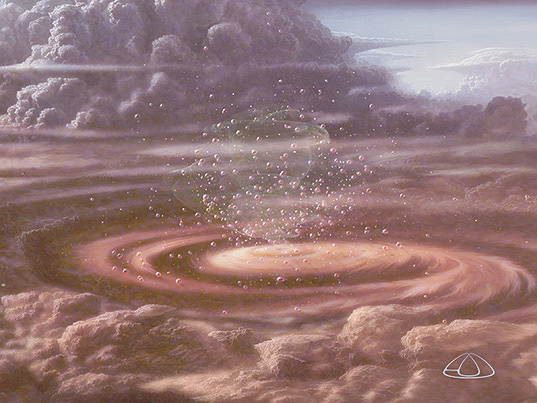
This painting speculates about possible forms of life on a Jupiter-like gas giant. Airbrushed water-based acrylic. 90 x 120 in (7.5 x 10 ft).
Dimensions: 90 x 120 inches (7.5 x 10 feet)
Medium: Airbrushed water-based acrylic.
Construction: The HFS mural consisted of nine 30 x 40-inch illustration board panels mounted on a plywood backing. The 30 x 40-inch boards were individually worked as separate panels before mounting using a high-quality rubber cement the day before the scheduled shooting. This operation included the application of a special tape and finishing touches to conceal the seams between the panels for the sequence shooting and photography for the book.
Image scale: 1 degree of arc : 1 inch. Its angular dimensions were thus a very wide-angle 90 x 120 degree view. The choice vantage point for a viewer appreciating the entire scene was directly over the center panel some 60 inches from the surface at that point. However, no attempt was made to introduce the distortion which would accrue from mapping a wide-angle area onto a flat surface. This was done in order to permit the camera to zoom in and pan, 'truck' or travel across any region of the painting without encountering any local distortions.
In September of 1978 I received a phone call from Jon Lomberg and Carl Sagan asking me if I would be interested in working on their upcoming PBS science series, "Cosmos". Without hesitation I said yes. They asked me about working on several subjects, but one in particular held a special significance for Carl, and he was keen to see the concept treated with as much realism and scientific accuracy as possible, as well as investing it with an aesthetic that evoked a sense of wonder. He wanted it to excite the imagination, to plausibly suggest what might be within the realm of natural possibility. I shared his enthusiasm for the topic; fortunately, I had good long head start on what would become an unexpectedly daunting and difficult challenge.
It just so happened that I had been producing a series of increasingly large paintings depicting the atmospheric environments of Jovian-class or gas-giant planets - panoramic cloudscapes - for quite a number of years previously, with the intention of eventually creating a series based on hypothetical organisms and even whole ecosystems which could conceivably evolve in such habitats. These early studies included illustrations which appeared in Astronomy magazine and educational slide sets produced by Encyclopedia Britannica (from 1974-1976), Starlog and Future-Life magazines (in particular, a scene depicting a balloon probe afloat above the cloudtops of Jupiter's Great Red Spot (1977), and a 30 x 40-inch Jupiter cloudscape depicting another balloon probe I had donated to the Flandrau Planetarium in Tucson in 1977-1978.
My principle sources of inspiration came seven years earlier. On one of my regular weekend visits to my favorite library back in 1971, I came across a new arrival in the science section: a copy of the book, "Intelligent Life in the Universe", by Iosif Shklovskii as expanded by Carl Sagan, published in 1968. I was 15 at the time, and that book completely absorbed me. Their description of a biosphere entirely suspended within and supported by an atmospheric environment was my first exposure to the concept. By the time I came across Arthur C. Clarke's 1972 short story, "A Meeting with Medusa" not long after my reading of Carl's Cosmic Connection in late 1973, I was enchanted by the concept. A burgeoning ecosystem of diverse creatures inhabiting the clouds of gas-giant planets became a preoccupation, stimulating my imagination in many detailed conceptual drawings and cloudscape studies.
I had by then already developed a serious interest in astronomy and physics with the goal of obtaining a degree, but reading this book (not long after studying Darwin's "On the Origin of Species", and Sagan's "The Cosmic Connection" later on in 1973) had a powerful influence on my thinking. It gathered my varied astrophysical interests and welded them together within the context of life: the nucleosynthesis of heavy elements, biogenic conditions in the interstellar medium, planetary formation and environments conducive to prebiotic chemistry, the establishment of microbial organisms and subsequent evolution and potential elaboration of complex multicellular organisms, ecosystems, societies, intelligence, technological civilizations, and so on. I studied everything I could get my hands on dealing with the subject. I began producing paintings and was immediately published. As it transpired, with all of the commissions I soon acquired, I suddenly found myself embarked on an early professional career as an astronomical artist.
I had also begun to train myself in the use of airbrushes to more easily and effectively accomplish the delicate details and appearance of clouds with quick-drying water-based acrylic paints. Since the age of 8 I had been an avid sky-watcher, a student of meteorology as well as an amateur astronomer. I had been fascinated by clouds for as long as I can remember. (My very earliest memory is of a cumulus-filled sky brightly back-illuminated by a high sun, over a wide tree-lined park; checking with my mother, I believe the observation occurred from a baby buggy my mom was pushing me along in as we strolled along a walk lining a lake shore park on the North Side of Chicago in the Summer of 1957 when I was perhaps 16 months old. It is an extremely vivid memory indelibly etched in my mind...I have even toyed with reconstructing that scene. I might attempt it one day, but it makes me nervous: it suggests an end to memory).
In any case, I had amassed a large collection of cloud photographs for my personal reference years before I had any intention of painting clouds. In 1974 I discovered the venerable Paasche model AB extra fine-line airbrush, an airbrush whose unique mechanical design had not significantly changed since the 1930's and was used for photo-retouching and by artists working on Walt Disney's early classic animated films including 'Fantasia'. This unit became my principle tool in the creation of most of my paintings, and it was the tool I introduced to all of the members of the team of the Cosmos Artists (as we were known) in order to facilitate a uniform consistency in the painted artwork for the visual effects which we were to prepare.
A
©Adolf Schaller
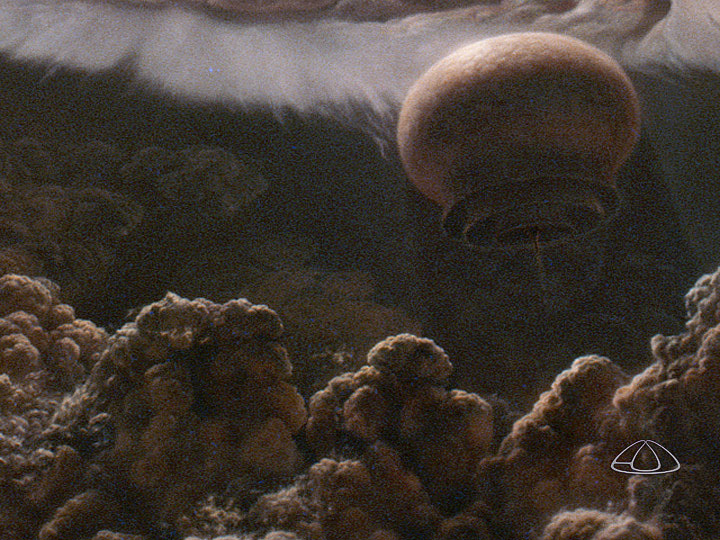
A "Floater" from Cosmos, Episode 2
Part of the larger mural, "Hunters, Floaters, and Sinkers" painted for the series.
Late that month of September, 1978, I was asked to immediately begin preparing preliminary concept drawings for what would become HFS while I was still at home in suburban Chicago. (At the same time I was also asked to begin painting a sequence consisting of four 15 x 20-inch panels depicting the final stages of our Sun's life, named by the title I gave to the first painting in the sequence, "The Last Perfect Day", which Carl subsequently altered slightly to, "The Last Good Day". That first painting was the very first of thousands of separate pieces of artwork I would contribute to the show over the better part of a year - from conventional paintings and artwork painted on flat acetate sheets for multiplane animation fx to tabletop models, planetary globes, asteroids and other models).
By the time I arrived in Los Angeles on February 13, 1979 to join the team of Cosmos Artists and work on the production of the visual effects, I had completed many dozens of preliminary concept drawings of the basic design of the HFS cloudscape environment, along with about a hundred conceptual designs for a variety of species of the three principle types which constituted the hypothetical biosphere and its ecological system: Hunters, Floaters and Sinkers - creatures with diverse shapes and anatomies, aerodynamic and buoyancy properties, propulsion mechanisms, feeding modes, social and navigation or migratory behaviors, communication, reproductive and defense and even stealth strategies, and more, that would not only fit them for life within a global atmospheric habitat, depending on conditions at various altitudes and within clouds of various composition, as well as the other dynamic aspects of weather, but also provide the basis for local or close-range interaction with other individuals of the same or different species, either in encountering those of their own kind (for reproductive purposes, or to maintain mutual proximity in gregarious social collections, for example), in encountering potential prey (Floaters grazed on diminutive but abundant Sinkers, while Hunters ambushed Sinkers for their stores of purified hydrogen as well as for nutrition), or encountered potential predators (both Floaters and Hunters could evolve elaborate defense strategies against attack by other Hunters). Carl's early speculations on Jovian atmosphere life in the 1960s had evolved and he eventually worked out the basic hunters, floaters and sinkers ecosystem which he described in a paper with Ed Salpeter: "Particles, Environments, and Possible Ecologies in the Jovian Atmosphere", which appeared in The Astrophysical Journal, Supplement Series in late 1975. Meanwhile I had been exploring the wide range of potential planetary habitats and designing a great many life-forms in the fleshed-out detail necessary for illustration, that could conceivably evolve and flourish within habitable environments, including Jovian-type atmospheres.
As I already mentioned, I had the benefit of a decent head start: I had been studying the range of potential conditions of gas giant atmospheres, considering those environments as potential habitats supporting hypothetical biological communities for years before I was called to work on Cosmos, and I had already composed a number of cloudscapes that prefigured HFS. In fact, much of the basic cloudscape is derived from the painting I donated to the Flandrau Planetarium in the spring of 1978, a work I had started on nearly 2 years before I commenced work on Cosmos that fall.
I began work on the main Cosmos VFX within several hours of my arrival. I was whisked from LAX to KCET-TV, which is located at the juncture of Hollywood and Sunset boulevards, stood around the offices for a while waiting on another team member, then off we went to the fx studio the show had contracted to perform the main fx, called Motion Pictures Incorporated (MPI) located over the Hollywood hills in Burbank to the north. The Cosmos Artists residence came to be called 'the Artists Apartment', which was actually a rented 3-bedroom house located in a relatively quiet residential neighborhood several blocks east and within walking distance of the KCET offices. We outfitted the house as an artist's studio, each of us working in their own bedrooms, or collectively in the living room/dining room on bigger projects like the large 4-foot diameter Earth globes - a surface globe prepared by Don Davis on which several of us pitched in on to help, and a separate 'cloud globe' of the same size that was my responsibility. The trip between the house to MPI in Burbank was our daily commute. That first night, returning from Burbank, and after that exhausting day that began early that morning in Chicago, I began work on HFS by preparing the first of what I thought would total at least three, but not exceed five 30x40-inch panels.
A Lazy Herd of Floaters
©Adolf Schaller
A Lazy Herd of Floaters
An updated digital restoration by Adolf Schaller of detail in his original Hunters, Floaters, Sinkers mural which appeared on Cosmos, Episode 2, which speculates about life in the atmosphere of a gas-giant planet.
That was to change drastically within the next month. The middle three panels covered the panorama centered along the horizon. I thought at first this might be sufficient, but I found that there would be many opportunities to explore the cloudscape far beneath and high above our apparent position (which I had calibrated by cloud type and other cues suggesting that the viewer was located at about the 1 bar level, assuming ideal smooth and laminar pressure gradient unaffected by weather). I had arranged for a wide-angle view with a scale of 1 Degree of arc to the inch.
It was an extremely exciting time for us: one must keep in mind this was just weeks away from the first of the Voyager flybys of Jupiter that March, and we all marveled at the awesome images Voyager had been returning of those incredible cream-in-coffee clouds with ever-increasing resolution. I was especially keen on studying them to gain some insights I could transfer into the painting. At the same time, I was preparing an accurately oblate 18-inch-diameter Jupiter model for several vfx sequences, and Voyager image prints made available to the press by JPL were indispensable references. Not every image Voyager returned was printed, however. I therefore petitioned to spend the night of closest approach at JPL so that I could study the raw images as they were displayed on the monitors.
As an aside, I should mention that we had visited JPL on several previous occasions to see Jim Blinn, who had created astonishing computer simulations of the Voyager flybys and who would be contributing a number of those along with other sequences to the show. Jim's groundbreaking work pioneered the digital fx revolution everyone enjoys in the motion picture industry today.
The computers he had at his disposal at JPL were costly, huge and slow by today's standards - it took many days for his setup to render sequences of a few minutes length. But the results were gorgeous and mesmerizing. I knew that I was seeing the future in his lab, but I never dreamed then that it would arrive as soon as it has and with such an astonishing boost of capacity and speed. Jim insisted he could never match the complex effects we were performing through traditional animation methods and camera moves on models and artwork, but it was certainly obvious to me that none of us could replicate the accuracy of the motions and trajectory of that little virtual Voyager I saw pirouetting on his monitors. Jim's sequences had the look of authenticity which was notoriously difficult to achieve via traditional vfx methods.
In any case, it was on one of those visits that I noticed there were half a dozen large monitors set up in an out of the way corner of the lobby to the von Karman auditorium, where members of the press congregated, and it occurred to me to be a perfect place to unobtrusively watch during the spacecraft's flyby. But it turned out that it was a surprisingly tough sell - nobody thought that an artist required any such referential input. This puzzling and exasperating attitude introduced me to a commonly held view amongst scientists and producers alike that art somehow springs spontaneously out of uninformed or unstimulated gray matter.
I was increasingly anxious as the flyby approached to have my request granted, so I asked to meet with Carl privately over at the Artist's Apartment. I had been enforcing a strict policy of keeping my work on the HFS panels under quarantine: nobody could see them except Carl and a few confidants on the team. The reason for this was to avoid unnecessary disruptions and preserve my concentration against the well-intentioned suggestions and advice of people. (I liken the phenomenon to rearranging the furniture physically without being able to visualize whether a given configuration is optimum: if it was up to some, a given project would change course so often it would never get done. The execution of a work is not a time to get distracted by experiment - that's supposed to be settled with the preliminary conceptual studies).
To my delight, I got my chance to plead my case: Carl accepted my invitation to stop by about a week before the flyby, and I displayed the three central panels arrayed along the horizon, propped up against the wall side-by-side, to show him how it was progressing. By that time I had finished most of the areas within 8 to 16 inches of the horizon centerline and had roughed out the rest of the cloudscape throughout the remaining area of the panels.
I was very gratified at Carl's reaction to it - he spent several long silent minutes in front of the panels, slowly shifting from one side to the other, his eyes scanning the detail along the horizon and the structures I had established above and below it. When he began to speak he grew really excited and I fielded his questions the best I could. I showed him what I had begun to prepare in two additional panels that could be positioned at the upper left and lower right corners to give the camera a view of regions close up, far down below and high overhead, where much of the details of the organisms that I had sketched could be established. I ventured the possibility of adding two more panels beneath and above the center panel as well, reiterated that the amount of work involved in covering so much area on these boards with a uniform level of detail was very time-consuming and laborious, and that the schedule may not permit me to get that far to finish those. He stood in front of the scene and stepped back a few paces as if to take in the entire scene in his imagination, while pondering silently for another full minute. Then he said, "Let's fill out the whole thing and make it a full nine panels."
My initial elation at his reaction to the painting turned to stark terror. I remember a very unpleasant queasy feeling in the pit of my stomach as my mind automatically calculated the area involved and I guess I was at a momentary loss for words. (10,800 square inches - 75 square feet of area to cover with millimeter resolution detail - it was petrifying). I finally managed to croak out something about how I didn't have enough time to devote to something that large and keep up my responsibilities with the rest of the effects. He simply said "Don't worry, we'll find a way", and just like that the matter was decided.
A Hunter
©Adolf Schaller
A Hunter
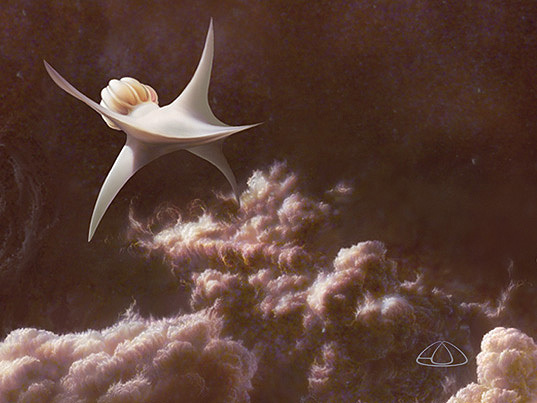
A speculative hunter animal evolved in the atmosphere of a gas-giant planet. Developed for Cosmos, Episode 2.
I must have been showing my shock, because he cheerfully changed the subject onto my request to go to JPL for the Voyager flyby. He reiterated the fact that he didn't want HFS to reflect an explicit association with Jupiter. I said I understood that perfectly that it was to be a portrayal of a hypothetical but generic gas giant world. But it was nevertheless an important opportunity to gain an insight into gas giant atmospheres. After all, Jupiter is a gas giant planet - and nobody had ever seen what those clouds really look like at the sub-km resolution that Voyager would soon return. I considered it vitally important to the painting, and I said so. It really is that important if an artist is expected to realize a visualization with maximum realism and accuracy. (It is generally under-appreciated that the task of portrayal compels artists to explicitly define the subject - we can't always enjoy the luxury of ambiguity in dealing with our subjects). I added that those monitors around the side of the auditorium lobby were all I wanted to be able to sit in front of so I could sketch and take notes. He smiled and nodded and said, "Good! I'll arrange it!" And with that our meeting ended.
So I was there at JPL during the flyby. As full of people as the auditorium was, that corner was deserted and eerily quiet all that night. But I didn't pay much attention to that. My eyes and attention were glued to the monitors and I was soaking in every image that came up. It was a mesmerizing night; it was as if my mind was transported to the spacecraft. The memory of it often returns to haunt me in quiet moments to this day...and, yes, it contributed a great deal - in some places crucially - to HFS. The main insight that was impressed on me that night was the prevalence of vortices and eddies, as especially evident in the turbulent region downstream of the GRS, and in the interactions between ovals and along the boundaries between bands and zones, right down to the limit of resolution. In suitably turbulent regions, vortices and eddies were evident down to the limit of resolution. That was the single most important insight I derived. It suggests the preponderance of vortices below mesocyclone scale, and the vigorous convection evident in many regions is more than sufficient implication: Jupiter and many other gas giant worlds with deep convective atmospheres must be full of tornadoes at every scale from the monstrous down to whirlwinds.
One consequence of the insight on the mural appeared in the form of a large cyclone reddened by a high population density of "Sinkers" (the analogue of plankton in earth's oceans) concentrated there to exploit nutrients updrafted from the depths below. Sinkers are comparatively tiny, ranging from microbial to large party balloons in size (many of the larger examples ranging upwards toward weather-balloon-size being newborn and juvenile Floaters and Hunters), so we only see the reddish coloration of the vortex from a distance of a few hundred kilometers, but their presence is also indicated by what they have attracted: a congregation of "Floaters" lazily grazing on them or giving birth to them in great numbers over the spot, in a vaguely helical pattern resembling the molecule of life. Strong convection and turbulence in Jovian atmospheres is often cited as a detriment to the evolution of organisms within them, yet such cyclones can conceivably play a crucially important role in concentrating nutrients and provide stable refuges.
I also added a more conventionally recognizable 'twister' emerging out from the ceiling of the canopy at the upper left because I wanted to give the camera a chance to come across one unobstructed funnel, and there was no other convenient place to place it. Its bothered me because strong vertical convection of the sort typically required to form them would normally not be taking place within a laminar stratus plume of that kind. It was placed there for the convenience of the shoot: it wouldn't be very noticeable in the long shots, but only when the camera panned over the region at close quarters, making the ceiling resemble the base of a convective cell.
I spent an estimated average of 4 hours of our typical 14-hour day on it every day over the following 7 or 8 months. Some days it was difficult to find a half hour for it - on those days I was too exhausted from pressing duties elsewhere in the fx production. To my dismay that workload had increased apace with the added challenge of filling out nine entire panels for HFS. The docket was exhausting.
I don't recall what month HFS was finally ready for the shoot. (I was far too exhausted by then to notice and, frankly, the Southern California climate doesn't provide one who grew up in the upper Midwest and used to annual snowfall enough cues to impress what season it might be...but I think it had neared the end of 1979 by the time I had finished HFS for the shoot). I do remember that the final push was a 2-week period staying permanently awake, like a zombie. It's like sleepwalking, except that though you know (or think you know) you are awake and your eyes are open, you are in a constant dreaming state. It was dreadful. I don't remember anything I painted during those closing weeks except for flashes of the final touch-ups on the stage at KCET. But I do remember it took me a very long time to recover.
The sequence was shot with director Adrian Malone having Carl physically walking, speaking and gesturing in front of it. Adrian meticulously choreographed the camera moves that panned over and zoomed into sections of the mural to show some of the detail in it with Carl's narrative voice-over. I was not present at the shoot: I was passed out in bed in our new apartment in Santa Monica, not remembering how I got there. I think I was out for almost 3 days. After HFS there were odds and ends as the work load rapidly eased off. It was the last major artwork or fx sequence of the production. It was rescheduled that way to help give me all the time possible (I'm pretty sure, under Carl's instructions) but it was The Monster among monsters.
Later the next year after Cosmos had aired, I and my fellow vfx colleagues (belonging to both the Cosmos Artists team and the crew who worked at Magicam noteworthy for their excellent Alexandrian Library and the Cosmic Calendar sequences) were awarded the 1980 Prime-Time Emmy Award for Outstanding Individual Achievement, Creative Technical Crafts. We assembled up on the stage and accepted the award to a long ovation. To my consternation my colleagues kept ushering me forward toward the dais to make the first comments. I was reluctant - I'm not good at speaking, let alone publicly. All I could manage was to thank my parents and a special friend for their support. But the one person who inspired me to explore the possibilities more than any other was Carl Sagan.
Source : http://www.planetary.org/blogs/guest-blogs/2013/20131023-on-hunters-floaters-and-sinkers-from-cosmos.html
lundi 15 septembre 2014

Des subdivisions administratives

Article de Theo Calderon

Voici quelques idées destinées à donner un peu d'épaisseur et de cohérence à ces secteurs et zones galactiques décrits un peu succinctement dans les Encyclopédies Galactiques. Commentaires et remarques sont les bienvenus.

Un District Galactique est un cube de 10.000 années-lumière de côté. Il y a 100 Districts Galactiques, identifiés par un chiffre romain. Le Ier District est celui abritant Prima, le IIème District celui situé à l'Est galactique du Ier, le IIIème celui situé au Sud galactique du IIème, et ainsi de suite dans le sens horaire.

Image

Allez hop, le secteur 412/39 est rebaptisé XXXième District Galactique.


Un Secteur Galactique n'a pas de taille définie, mais c'est au minimum un volume d'espace cubique de 1.000 années-lumière de côté, contenu à l'intérieur d'un District Galactique. On y trouve plusieurs types d'espaces territoriaux aux statuts juridiques différents :

Baronnie Impériale

C'est un ensemble de systèmes planétaires tous placés sous la tutelle d'un membre de la noblesse locale, représentant de l'autorité impériale. Selon les cas, il porte le titre de Baron, Vice-Roi, Lord, Siridar ou Connatic, en fonction de l'héritage historique du secteur. Par exemple, le Baron Anthon de la Fiertayade dans le Secteur Gandalf, Sa Grâce le Baron Drugan Malevoy de Kerzut dans le Secteur du Trèfle, Lord Valentin de Majipoor dans le secteur éponyme.
Les systèmes qui composent une Baronnie abritent :


  • des mondes de niveau galactique NT6 (ex : Vonda, Tréfolia, Mandrake, Terra Formata, etc...).
  • des colonies de peuplement en cours d'écoformation (NT5 ou 6 selon l'ingénierie planétaire requise) et des colonies d'exploitation minière ou agricole (ex : Kharg NT5), ou encore des planètes de villégiature (ex : Prénuptia). Ces mondes peuvent parfois être habités par une civilisation autochtone NT1 parquée dans des réserves. Ils dépendent généralement de la métropole impériale NT6 la plus proche qui finance leur développement et délègue un Gouverneur Général pour l'administrer.
  • des mondes abritant des civilisations autochtones NT2 et NT3, placés en quarantaine par le Bureau des Affaires Indigènes, dont l'Empire attend le développement autonome et l'accès au NT4 pour les intégrer à la société galactique.
  • des planètes-bagnes (ex : Cerbère NT2) ainsi que parfois des mondes placés sous Restriction Technologique (NT3 ou NT4) par mesure de rétorsion politique (à cause d'éléments non contrôlés s'opposant aux autorités impériales).
Chaque monde de la Baronnie est libre d'adopter son propre système de gouvernement. Un nombre variable de Conseillers Planétaires dépendant du poids démographique de la planète est désigné (par vote ou par nomination) pour la représenter à l'Assemblée Sectorielle. Les membres de l'Assemblée Sectorielle choisissent (élisent ou nomment) à leur tour les Délégués qui vont siéger à la Chambre des Pairs sur Prima.

Protectorat Impérial

C'est un ensemble de systèmes planétaires, des unités politiques rattachées à l'Empire par des traités de défense, des accords économiques privilégiés, mais sans avoir intégré encore celui-ci. Les autorités gouvernementales du Protectorat envoient également des Délégués à la Chambre des Pairs, mais s'ils peuvent participer aux débats, ils n'ont pas le droit de voter les résolutions.

Provinces Souveraines

Il s'agit d'entités politiques distinctes de l'Empire, commerçant éventuellement avec lui, mais disposant de leurs propres forces de défense (ex : l'Alliance des Douze Soleils, la Confédération de l'Amas de Gion, la République du Cygne, la Coalition des Mondes Agrippins, les Territoires Kiffish). Ils peuvent envoyer des observateurs à la Chambre des Pairs, mais ils ne peuvent prendre part aux débats (ceux enregistrés au Journal Officiel...) que s'ils y ont été autorisés par décision du Premier Orateur de la Chambre, généralement à l'issue de grandes manoeuvres diplomatiques.

Systèmes Extérieurs

Il s'agit de mondes indépendants, qui ne sont rattachés à aucune des entités politiques de leur Secteur Galactique, de niveaux technologiques très disparates (ex : Brénus, Estébois, Jonction, Tortuga). Leurs seules relations avec le reste de l'Empire (quand ils en ont) sont de nature commerciale.

Source : http://www.encyclopedie-galactique.com/viewtopic.php?f=5&t=1861

dimanche 14 septembre 2014

Les descendants de la dynastie impériale Boro (période 9320-9512) quelques décennies avant le Jihad Butlerien (9799-9892)

The Fallen Emperor, was the last Emperor of the decadent Old Empire; he witnessed its fall and the rise of the Titans.
His name is forgotten and lost in history (though probably known to Leto Atreides II and Ghanima from their genetic memories), however millennia later, his lineage would still exist however; Camie Boro was a direct descendant of him.


Camie Boro (224 BG - 110 BG) was the last known descendant of the fallen Emperor of the Old Empire during the Butlerian Jihad. Iblis Ginjo married her to improve his political power and image.
Although they had three kids together, the marriage was clearly a political convenience and the two spoke mainly when in public.
After Ginjo's death, Boro succeeded him as Grand Patriarch and was essential in the machinations that covered his crimes during the war and cleaned out his name, redirecting the accusations towards the 'traitor' Xavier Harkonnen. Along with Yorek Thurr they led the Jihad Council and she proposed the construction of the monument to the Three Martyrs.
Camie Boro succeeded her husband promising Thurr to be her successor, however ten years later she resigned and denied him the succession and placed her own son, Tambir Boro-Ginjo in the throne of the Grand Patriarch. Thurr then feigned his death in a ship explosion and went to the Synchronized Worlds.
Later, she put her grandson (of her other child) Xander Boro-Ginjo to succeed her son in the position of the Grand Patriarch.

Tambir Boro-Ginjo (192 BG - 110 BG) was the son of Iblis Ginjo and Camie Boro.
Camie Boro denied Yorek Thurr the succession of Ginjo, placing her own son in the position of the Grand Patriarch in 154 BG.
During his days, officers of the Army of the Jihad discovered Norma Cenva's navigation computers, that caused an uproar that nearly shut down the Kolhar shipyards. Norma had been baffled, citing the evidence of success and pointing to the greater good the superfast ships would do for the Jihad. But Tambir had been apoplectic about the "deceit" Norma had attempted to perpetrate.
He apparently died without heirs and the title was succeeded by his nephew, Xander Boro-Ginjo.


Xander Boro-Ginjo [d. 88 BG] was the son of Rellon Boro-Ginjo, grandson of Camie Boro and Iblis Ginjo.
He succeeded his uncle, the Grand Patriarch Tambir Boro-Ginjo who apparently died without heirs.
He was the father of Jessica Boro-Ginjo, the later wife of Viceroy Faykan Butler.
When Yorek Thurr escaped the blockade of Corrin, he returned to Salusa Secundus. There he sneaked into Grand Patriarch's office and introduced himself, asking him to resign for his favor. Thurr then was ousted by the Patriarch's guards.
In a following night, Thurr once more sneaked into his mansion, this time in his bedroom while the Grand Patriarch was sleeping. He paralyzed his vocal cords and forced an audience. Once more he asked from him to resign so that Thurr could take his place, promised by his grandmother years ago.
When Xander Boro-Ginjo tried to escape from his grasp, Thurr strangled him and wore his chain of office, a chain which he and Camie Boro had designed.


Jessica Boro-Ginjo [b. 132 BG] was the daughter of Xander Boro-Ginjo and niece of the Grand Patriarch Tambir Boro-Ginjo.
In 100 BG, while her father reigned as Grand Patriarch, she married Viceroy Faykan Butler.

Sources :  http://dune.wikia.com/wiki/Fallen_Emperor , http://dune.wikia.com/wiki/Camie_Boro , http://dune.wikia.com/wiki/Tambir_Boro-Ginjo , http://dune.wikia.com/wiki/Xander_Boro-Ginjo et http://dune.wikia.com/wiki/Jessica_Boro-Ginjo

vendredi 12 septembre 2014

LEARN TABLETOP ROLEPLAYING GAMES - Find the Best Science Fiction Game for Your Group

Just as there really is no such thing as a best book or movie, there is no best roleplaying game, or even best in a particular category. But if you’re looking to try something new, this selection should help. The games were selected to cover a wide spectrum of game mechanics, settings, and play styles. Some are well known, others relatively obscure. Some are licensed from video games, movies, TV shows, or books. Some are free for download, and several provide free quickstart PDFs.
Each of these images links to a full writeup about that game, including overview information, three of the things that make the game stand out out, purchasing information, and links to reviews and community sites.

3:16 Carnage Amongst the Stars

Some games are subtle. Some games hit you over the head with their simplicity. Very few games allow you to quickly and easily jump into the action, then slowly reveal subtleties after repeated play. 3:16 Carnage Amongst the Stars is one such game.
3:16 Carnage Amongst the Stars is a grim, brutal game of interstellar war in very personal terms.Suitable for one-offs or campaign play, 3:16 can be used to run straight-up Aliens-style bug hunts or extended deployments in which characters advance in rank and have to grapple with more complex moral issues.
Here’s how the creator of 3:16 describes the game:
  • Elegant, simple game system
  • Very low-preparation to start
  • Complete game in one book
  • Designed for campaign play

Three Things About 3:16 Carnage Amongst the Stars

  • Simple, Lethal Mechanics: This game uses straightforward conflict resolution mechanics, and the possibility of character death is everpresent.
  • Focused Setting: Player characters are members of the 16th Brigade, 3rd Army Expeditionary Force, sent by the Terran Council to wipe out any and all alien threats. The mechanics are, however, straightforward enough to allow the game to be hacked to suit the military sci-fi setting of your choice.
  • Flashback Character Exposition: Character creation is extremely fast, but over the course of play more is revealed about characters through “Flashback” moments that affect the course of events.

Eclipse Phase

Looking for a meticulously-detailed, immersive science fiction setting that will stretch your imagination? Ready for crunchy d100 rules tailored for simulationist play? Eclipse Phase may be the game for you.
Earth has been abandoned by most of humanity after a massive AI uprising left it barren. The rest of the solar system has been colonized by augmented humans, uplifted animals, and other forms of transhuman life. The conservative Inner System governments, hypercorps, anarchists of the Outer System, and everyone in between jockeys for power, even as new threats to transhumanity’s survival emerge.
eclipse-phase-hero
The AIs that started the war still linger in hidden pockets. Strange unknowable aliens have appeared, and mysterious gates enable travel to planets far from the solar system. Behind it all a greater danger lurks. Player characters work for Firewall, a secret organization dedicated to confronting these threats. Unknown horrors await!
Here’s how publisher Posthuman Studios describes Eclipse Phase:
  • Your mind is software. Program it.
  • Your body is a shell. Change it.
  • Death is a disease. Cure it.
  • Extinction is approaching. Fight it.

Three Things About Eclipse Phase

  • A Tremendously Detailed Setting: Everything from political and economic systems to space habitats, mesh hacking, and nanoviruses is defined in detail.
  • Death is a Thing of the Past: The ability to disassociate the mind from the body and back up one’s consciousness is a core tenet of the game, and it deeply affects game play.
  • d100 Mechanics: The skills-driven d100 mechanics will be familiar to anyone who has played RuneQuest or any other Basic Roleplaying-derived game. You can also run an EP camphttps://www.blogger.com/blogger.g?blogID=4437120060500409634#editor/target=post;postID=2642183304988119537aign using Fate Core mechanics.

Microscope

Microscope is unique. It can be used to model the events of a region, a continent, a world, or a galaxy. It can cover years, decades, centuries, or millennia. Creation of a collaborative history is the name of the game. While Microscope can be played as a stand-alone affair, many groups use it in to establish the backstory and setting for a campaign to be played using another game.
Here’s how the publisher describes Microscope:
Mock chronological order. Defy time and space. Build worlds and destroy them. A role-playing game for two to four players. No GM. No prep. Microscope was playtested for two years by over 150 awesome gamers.

Three Things About Microscope

  • Worldbuilding: Microscope is all about worldbuilding. The worlds you build can be an end to themselves, or be used as the basis for a campaign that uses another RPG.
  • Collaborative: There is no GM in Microscope, and the focus of the game is on collaborative creation.
  • Variable Depth: The outline of the history you create can stretch through thousands of years and still have myriad discrete moments where the course of events hinges on individuals.
Responsive image

Mindjammer

Using Fate Core mechanics, Mindjammer takes place in a space opera setting that incorporates faster than light travel, virtual reality, transhumanism, genetic engineering, conflicts of all kinds, aliens, and more. The rules can be also be used to run campaigns in settings of your own creation.
This is a game well-suited to campaign play, with a solid emphasis on narrative.
Here’s how the publisher describes Mindjammer:
Never has there been a greater time of opportunity. The universe is in flux, and for the first time in ten thousand years no one knows what the future will bring. Charge your blaster, thoughtcast your orders to the starship sentience, and fire up the planing engines. Come and defend the light of humanity’s greatest civilisation as it spreads to the stars!

A Few of the Things That Make Mindjammer

  • Incorporates Fate Core Rules: The Fate Core rules are baked into the game, which means Fate Core is not required. It also means system tweaks designed for Fate Core can be incorporated into Mindjammer.
  • Leverages an Array of SciFi Tropes: This game really covers everything, from the intersection of humans and machines to exploration of the vast reaches of the galaxy to the subtleties of interspecies interaction.
  • Suitable as Setting or Toolkit: The New Commonality of Humankind is a fully-developed setting, but it is presented in a way that provides for everything from tweaking to full overhaul.
Responsive image

Numenera

In Numenera the tremendously advanced technologies developed by long-dead civilizations linger on in a low-tech world where people struggle to survive. Adventurers attempt to gather and harness this dangerous, powerful magic in order to build a better future.
Characters in Numenera come from one of three broad classes and advance by gaining experience points, but those traditional d20 mechanics are married to newer elements that offer a great deal of narrative control to players. It is a medium-crunch system delivered with plenty of advice for gamemasters. While it can be used for one-offs, Numenera is best suited to campaign play.
Here’s how the publisher describes Numenera:
Set in a far, far distant future, the Numenera RPG puts a new spin on traditional fantasy, creating something unique to reinvigorate the imagination of gamers everywhere. Player characters explore a world of mystery and danger to find leftover artifacts of the past: bits of nanotechnology, the datasphere threaded among still-orbiting satellites, bio-engineered creatures, and myriad strange and wondrous devices that defy understanding.

Three Things About Numenera

  • A Unique Post-Apocalyptic Setting: Set in earth’s far distant future, technology advanced enough to be indistinguishable from magic coexists with agrarian economies, alien species, and unrecognizable creatures.
  • Character Differentiation: A character type is joined with a descriptor and focus to rapidly generate a unique character.
  • Streamlined NPCs and Monsters: A non-player character or monster’s level determines attack and defense targets, so gamemasters have less work to do up front when creating encounters.
Responsive image

Shadowrun

First published in 1989, Shadowrun blends cyberpunk and fantasy to create a near-future world in which player characters engage in corporate espionage and other dirty work, using magic, technology, and cunning.
The fifth edition consists of the Shadowrun Beginner Box Set and the Shadowrun Core Rulebook, each of which are stand-alone games.
Here’s how the publisher describes Shadowrun:
Shadowrun, Fifth Edition is the newest version of one of the most popular and successful role-playing worlds of all time — a fusion of man, magic and machine in a dystopian near-future. With rules for character creation, magic, combat, Matrix hacking, rigging, and more, you have everything you need to face the challenges of the Sixth World.

Three Things About Shadowrun

  • A Tremendously Detailed Game World: The future history of Shadowrun has been extensively developed over the past 25 years, giving gamemasters a vast palette for creating adventures.
  • The Blending of Technology and Magic: From shamans to riggers, dragons to hovertanks, the Shadowrun rules incorporate virtual reality, advanced technology, and magic of all stripes.
  • Dice Pool Mechanics: If you like rolling lots of six-sided (‘normal’) dice, this is the game for you.
Responsive image

A Song of Ice and Fire

This is a game tailored for the Seven Kingdoms setting from George R.R. Martin’s books and the A Game of Thrones TV show. The intrigue between the noble houses is just as important as the actions of individual characters; players actually create a house before creating individual characters. In keeping with the source material, this is as much a game of guile and subterfuge as of clever fighting.
A Song of Ice and Fire: A Game of Thrones Edition focuses on replicating the breadth of political, military, and individual confrontations found in The Seven Kingdoms. With medium complexity rules, deadly combat, and ongoing political intrigue, this game is made for campaign play in the grim, high fantasy, low magic world of the Seven Kingdoms.
Here’s how the publisher describes A Song of Ice and Fire:
A Song of Ice and Fire Roleplaying gives you everything you need to play and run games in the Seven Kingdoms using an easy to learn system specifically designed to evoke the atmosphere of the best-selling novels and hit TV show.

Three Things About A Song of Ice and Fire

  • Noble Houses: The creation of the noble house your characters serve is it’s own mini-game, with rules covering relationships with other houses, creation of a coat of arms, and more.
  • Destiny Points: Players may spend Destiny Points to change the course of events in a minor way, burn them to affect major events, or invest them to acquire permanent benefits.
  • Intrigue Rules: Secret plans, subtle manipulations, and the cultivation of political and social influence are core to the A Song of Ice and Fire books, and the game’s Intrigue mechanics bring those elements to life.
Responsive image

Star Wars

One Galaxy – Three Games
The Star Wars galaxy is vast. It has been explored in six movies, dozens of novels and cartoon episodes, and hundreds of comics. With the dawn of the Disney Era of Star Wars, this galaxy will be getting fleshed out in even further detail for years to come.
Given the breadth of the Star Wars setting, it’s not surprising that when it took over the license for Star Wars tabletop RPGs, Fantasy Flight Games elected to create three different flavors of the game, all using the same mechanics, but each emphasizing a different aspect of everyone’s favorite far, far away galaxy. Each is set in the interval between episodes IV (A New Hope) and V (The Empire Strikes Back), but creating a campaign set after The Empire Strikes back wouldn’t require much effort using any of these books.
FFG has released boxed beginner sets and a core book for each of the games. The rules for all these games games use destiny points and a set of special dice to drive a narrative approach to task resolution.
Star Wars is oriented toward campaign play. Character specialization and advancement are familiar to anyone who has played a classes-and-levels game, and the narrative mechanics support the system’s overall emphasis on simulating the pulp feel of the movies.

Three of the Things That Make Star Wars Stand Out

  • A Familiar Universe: You’ll be hard-pressed to find someone who isn’t at least familiar with the Star Wars universe, which makes it easy to pitch the game to players, and easy for players to situate themselves in the game world.
  • Special Dice: A set of special dice (included in the boxed set) are used to generate a cinematic success/failure and advantage/disadvantage outcomes from a single roll.
  • Tie-ins: Characters, equipment, NPCs, and storylines from each game can be seamlessly incorporated into the others.

Edge of the Empire

star-wars-edge-of-the-empire-hero
Han Solo. Lando Calrissian. Boba Fett. Jabba the Hutt. These smugglers, scoundrels, bounty hunters, and crime lords of the grimy, desperate Outer Rim are the kinds of characters that occupy Edge of the Empire. If the grubby side of Star Wars appeals to you, this may be your game. Typical Edge of the Empire adventures include heists, treasure hunts, protection missions, investigations, smuggling runs, and the like.Players can take the role of Bounty Hunters, Colonists, Explorers, Hired Guns, Smugglers, or Technicians. The core rulebook defines three specializations for each career (ex: Bodyguard Hired Gun), so you wind up with 18 character types. Player characters can be Bothan, Droid, Gand, Human, Rodian, Trandoshan, Twi’lek, or Wookie.
Edge of the Empire uses a story mechanic called Obligation. Obligations are debts, favors, or other responsibilities owed by player character. Gamemasters can use Obligations to put pressure on characters, give them access to resources they wouldn’t otherwise have, and introduce new adventures.
The Force plays an ancillary role in Edge of the Empire; the Force-Sensitive Exile specialization can be taken with any career and provides some nifty capabilities, but characters with Force sensitivity are mostly untrained and hiding their talents for fear of being discovered by the Empire.

Traveller

The first edition of Traveller was released in 1977. Its central themes of interstellar travel, trade, and warfare caught on and it went on to become the de facto science fiction RPG.
Since then it has undergone several revisions, including the massive 655-page Traveller5: The Ultimate Edition. The most current version, published by Mongoose Publishing, is much more accessible to Traveller neophytes. That is the version discussed here.
In Traveller characters go through a series of careers, accumulating skills along the way, before they enter play. The game mechanics rely on a straightforward d6-based system.
While the default Third Imperium setting is used for many game supplements, the rules are generic. Referees (gamemasters) can easily create their own settings. Traveller is well-suited for campaign play with a hard SF flavor.

Three Things About Traveller

  • The Original SF RPG: If you want to run a campaign built around the hard scifi of galaxy-spanning adventures, spaceship combat, and discovery.
  • Simple Mechanics: Traveller uses d6 (‘normal’ dice) coupled with attribute and skill modifiers, which makes for streamlined task resolution.
  • Back Catalogue: Many supplements were created for the original GDW edition of Traveller, and Mongoose has re-released several of them.
Responsive image

Source : http://learntabletoprpgs.com/science-fiction-roleplaying-games.html

jeudi 11 septembre 2014

Citadelle

La Citadelle est une ancienne station spatiale dont la construction est attribuée aux Prothéens. Depuis l'extinction de la race prothéenne, de nombreuses espèces s'y sont installées. La Citadelle fait office de capitale à la fois politique, culturelle et économique de la communauté galactique. Pour défendre leurs intérêts, la plupart des espèces possèdent une ambassade dans l'anneau central de la station, le Présidium.
La Tour de la Citadelle, au coeur du Présidium, abrite la Chambre du Conseil, dont les décisions ont un impact considérable sur la communauté galactique. Cinq bras gigantesques, connus sous le nom de Secteurs, s'étendent depuis le Présidium ; les Secteurs sont eux-mêmes de véritables villes peuplées de millions d'habitants venus de la galaxie tout entière.
La Citadelle est pour ainsi dire indestructible. En cas d'attaque, elle peut replier ses bras pour former une carapace la rendant inexpugnable. Depuis qu'elle existe, la Citadelle est entretenue par une espèce étrange que l'on appelle les Veilleurs.

 http://img4.wikia.nocookie.net/__cb20110228230033/masseffect/fr/images/2/26/316px-Cd2c00citadel.jpg

Données Statistiques

Bien que la Citadelle soit équipée de noyaux d'élément zéro, la gravité à bord de la station est générée par la force centrifuge de la rotation.
Rotation : 3,5 min/révolution
Gravité rotationnelle dans les secteurs : 1,02 g
Gravité rotationnelle dans le Présidium : 0,3 g
Longueur totale (position ouverte) : 44,7 km
Diamètre (position ouverte) : 12,8 km
Longueur des Secteurs : 43,6 km
Largeur des Secteurs : 330 m
Diamètre de l'anneau du Présidium : 7,2 km
Largeur de l'anneau du Présidium : 553 m
Épaisseur du blindage externe : 13 m
Population : 13,2 millions (Veilleurs non inclus)
Masse totale : 7,11 milliards de tonnes
Hauteur de la tour du Présidium : 1 047 m


Fondations

Les Fondations sont situées sur la face inférieure des Secteurs, entre les superstructures habitées et l'impénétrable coque extérieure. Officiellement, seuls les Veilleurs sont autorisés à pénétrer dans cette zone où sont regroupés systèmes de survie et centrales électriques. Mais les Fondations sont depuis bien longtemps les taudis de la Citadelle, repaire des criminels, des minorités, des marginaux et des parias. Tous ne viennent pas là de leur propre gré : plus d'un rêve est venu se briser contre les murailles de la Citadelle.
Les Fondations abritent également des usines de recyclage où sont fabriquées des pâtes nutritives organiques gratuites mais sans saveur. Les résidents les plus pauvres doivent pourtant s'en accommoder, à grand renfort de sauces et d'épices, car les produits d'importation sont un luxe réservé aux plus riches.

L'anneau du Présidium


Citadelle2
Vue à l'intérieur de la Citadelle
L'anneau central de la station est un tore paysager qui connecte les Secteurs entre eux. Il abrite en outre les ambassades des espèces influentes de la galaxie ainsi que les résidences privées de l'intelligentsia.
Le Présidium abonde en restaurants, bars et autres lieux de rencontre luxueux. La principale caractéristique qui le différencie des Secteurs est son cycle jour-nuit, respectivement de vingt et six heures, simulé par un "ciel" holographique projeté au plafond. La Gravité y équivaut à 1/3 de la Terre.
Les bureaux et résidences donnent souvent sur l'intérieur. Il n'est pas rare de voir une résidence d'ambassadeur sans enceinte aucune. Ce n'est pas pour autant un vecteur d'insécurité : grâce à la présence permanente du SSC et aux systèmes de surveillance du Présidium, les criminels potentiels sont rapidement identifiés et appréhendés.
L'anneau abrite également les spatioports de la Citadelle, car la proximité de l'axe de rotation facilite l'amarage des vaisseaux et la manipulation des marchandises. Des centaines de vaisseaux transitent quotidiennement par la Citadelle. Chaque espèce dotée d'une ambassade dans la station possède également un quai sur les docks.
La Tour qui se dresse fièrement à environ un Kilomètre au dessus de l'anneau, parallèle aux bras des Secteurs, héberge l'administration du Conseil. Comme elle constitue l'axe de rotation de la Station, elle n'est quasiment pas sujette à la force centrifuge et sa gravité est maintenue à l'aide de champs gravitationnels selon un angle de 90° par rapport à l'anneau et aux Secteurs.
Un quai consulaire se trouve également au pied de la Tour afin d'accueillir les vaisseaux diplomatiques et ceux des Spectres, ou de permettre l'évacuation du gouvernement en cas d'urgence.

Secteurs


Secteurs
Secteurs
Les Secteurs, ces cinq énormes bras qui entourent la Citadelle, sont les principaux centres démographiques de la station. Chaque bras est à lui seul une énorme cité, composée de quartiers résidentiels et commerciaux extrêmement cosmopolites. La densité de population et le coût de la vie sont très élevés, à l'instar des mégalopoles terriennes comme Hong Kong et Singapour.
Les Secteurs ne possédant pas de toit, les gratte-ciels s'élèvent de la superstructure pour atteindre le vide spatial. Bien entendu, les tours sont pressurisées car l'atmosphère respirable s'élève à environ 7 mètres du sol. L'atmosphère est maintenue en place à l'aide de champs gravitationnels et d'une « membrane » de soufre hexafluorure, un gaz dense et incolore.
La vue depuis les Secteurs est spectaculaire : à l'arrière-plan, des étoiles à perte de vue, la nébuleuse du Serpent et la Veuve, une géante bleue toute proche ; au premier plan, les lumières des bâtiments et des véhicules des autres Secteurs. La Citadelle ne possède pas de véritable cycle jour-nuit. Même si elle est soumise à l'heure galactique standard pour des raisons politiques, les commerces ferment rarement et ses habitants adaptent leur cycle de sommeil en fonction de leurs besoins et non d'un rythme circadien.
De nouvelles constructions sont sans cesse ajoutées, qui doivent respecter un lourd cahier des charges afin de ne pas compromettre le bon fonctionnement de la station. De temps à autre, des Veilleurs se rendent dans une zone des Secteurs et déplacent ou modifient l'architecture sans raison apparente. Les résidents ont appris à vivre avec ces intrusions permanentes.

Loisirs

La Citadelle contient plusieurs centres de loisirs, dont un Bar "L'Antre de Choras et bien d'autre" et une sorte de Casino. Vous y trouverez également les appartements de la "Favorites", Asari très prisée où il est difficile d'obtenir un Rendez-vous.
Art citadelle
Dessin conceptuel représentant les loisirs de la Citadelle
 
Vues extérieures 


Prothéens

Cinquante mille ans avant les évènements prenant place dans le premier épisode [du jeu Mass Effect], les Prothéens étaient la seule espèce à pouvoir voyager dans la galaxie. Apparemment très avancés technologiquement, ils ont néanmoins disparus brutalement, sans laisser d'autres traces connues que des vestiges de leur civilisation. Les seuls reliques supposées de leur empire sont: les relais cosmodésiques et la Citadelle, qui ont permis l'expansion galactique des différentes races en présence dans Mass Effect. On trouve des ruines prothéennes sur de nombreuses planètes à travers la galaxie.
Bien qu'étonnamment intactes pour leur datation, les exemples de paléotechnologies prothéennes fonctionnelles sont rares. Avec l'œuvre du temps et des générations de pillards, leurs villes et stations abandonnées ne sont plus que des coquilles vides. Certaines thèses prétendent que les Prothéens seraient intervenus dans l'évolution des races les plus jeunes. Sur Kahjé, la planète d'origine des Hanari, on trouve ainsi des traces évidentes d'une ancienne occupation prothéenne. De même, la découverte d'un ancien poste d'observation prothéen sur Mars a provoqué une recrudescence de théories sur une possible intervention extérieure dans l'évolution de l'espèce humaine : selon ces théories, les mythologies et religions des civilisations anciennes seraient en fait des erreurs d'interprétation de rencontres du troisième type bien réelles.

 http://img4.wikia.nocookie.net/__cb20120325182233/masseffect/fr/images/e/e2/Proth%C3%A9en.jpg

Mass Effect

Après la découverte d'une balise prothèenne sur Eden Prime , artefact majeur pour le développement des espèces, le commandant Shepard est saisi de mystérieuses visions. Après de nombreuses péripéties, et avec l'aide du docteur Liara T'Soni, il est révélé qu'il s'agissait d'un message prothéen, destiné à mettre en garde la galaxie contre la menace des Moissonneurs , l'espèce à l'origine de l'extinction des Prothéens, et véritables créateurs des relais et de la Citadelle.
Lors de leur passage sur Ilos, le commandant et son équipe découvrent les traces de Prothéens ayant fuit devant l'imminence de l'extinction de leur race. Des centaines de modules de stase, censés conserver les derniers représentants de l'espèce en vie, jusqu'à la fin de la guerre, malheureusement éteints depuis longtemps, faute de source d'énergie. Une dernière I.V prothéenne, endommagée: Vigil, veillant sur le canal, donne à l'équipage les dernières informations lui manquant afin d'arrêter Saren et les Moissonneurs.

Mass Effect 2

Dans Mass Effect 2, une fois la base des Récolteurs infiltrée, le commandant et son équipe se rendent compte que leur ennemis sont en réalité ce qu'il reste des Prothéens, modifiés génétiquement et réduits en esclavage par les Moissonneurs. Complètement endoctrinés et incapable du moindre discernement, ils furent chargés des enlèvements sur les différentes colonies humaines et sont responsables de la destruction du Normandy SR-1.

Mass Effect 3

Le troisième épisode de la trilogie introduit le dernier représentant de la race encore en vie: Javik, découvert sur Eden Prime et disponible en tant que coéquipier.